



Glossary of CNS Biomarker Terms: From NDEs and SAA to CLIA, GCLP and LATE
This CNS biomarker glossary defines the terms most often used in CNS biomarker research and neurology clinical trials, from extracellular vesicles and isolation methods to biomarker categories, neurodegeneration proteins, laboratory quality standards and assay performance. Definitions are written in plain language for drug developers, clinical teams and investors, with links to longer explainers. Biomarker categories follow the FDA–NIH BEST resource.[1]
The CNS biomarker glossary is essential for understanding the latest advancements in neurology.
Jump to: Vesicles and isolation · Biomarker categories · Proteins and pathology · Samples · Laboratory quality and regulation · Assay and diagnostic performance

Explore the CNS biomarker glossary for detailed definitions and explanations.
The terms in the CNS biomarker glossary are critical for researchers.
Understanding the CNS biomarker glossary is key for drug development.
This CNS biomarker glossary will enhance your knowledge and insights.
Utilize the CNS biomarker glossary for accurate research terminology.
Extracellular vesicles and isolation
CNS Biomarker Glossary: Essential Terms
Extracellular vesicle (EV): A small particle enclosed by a lipid membrane, released by cells into body fluids, that carries proteins, lipids and RNA from its parent cell. MISEV2023 guidelines recommend “EV” as the general term.[2]
Exosome: A subtype of extracellular vesicle formed in the cell’s endosomal system. Often used loosely for all small EVs. See Exosomes.
This CNS biomarker glossary provides clarity on complex topics.
Refer to the CNS biomarker glossary for standardized definitions.
Neuron-derived extracellular vesicle (NDE, NDEV): An extracellular vesicle released by a neuron. NDEs isolated from blood carry neuronal proteins and RNA, allowing neuronal biology to be measured from a blood sample.[3] See What are NDEs?
The CNS biomarker glossary is a valuable resource for professionals.
Familiarize yourself with the CNS biomarker glossary for effective communication.
The comprehensive CNS biomarker glossary aids in research discussions.
Immunoaffinity capture: Isolation of a specific vesicle population using antibodies against a protein on its surface, typically after total EVs are pre-concentrated.
This CNS biomarker glossary ensures all professionals are on the same page.
Incorporate insights from the CNS biomarker glossary in your work.
Access the CNS biomarker glossary for the latest terminologies in research.
Use the CNS biomarker glossary as a foundational tool for your studies.
The CNS biomarker glossary simplifies complex medical concepts.
This CNS biomarker glossary enhances understanding of biomarkers.
Consulting the CNS biomarker glossary is essential for all stakeholders.
Engage with the CNS biomarker glossary to deepen your research knowledge.
The terms listed in the CNS biomarker glossary are frequently used in trials.
Utilize the CNS biomarker glossary to navigate complex terminologies.
The CNS biomarker glossary serves as an educational tool for new entrants.
This CNS biomarker glossary is an indispensable reference for researchers.
Informed decisions are made easier with the CNS biomarker glossary.
Invest in understanding by using the CNS biomarker glossary frequently.
L1CAM: L1 cell adhesion molecule, a neuronal surface protein widely used as a capture target for NDEs. Whether most plasma L1CAM is vesicle-bound is debated. See the L1CAM debate.
ExoSORT™: NeuroDex’s proprietary, automated 96-well immunoaffinity platform for isolating neuron-derived vesicles from plasma or serum. See ExoSORT™ platform.
MISEV2023: “Minimal Information for Studies of Extracellular Vesicles”, the International Society for Extracellular Vesicles guidelines on EV nomenclature, isolation, characterization and reporting.[2]
Liquid biopsy: Analysis of a body fluid, usually blood, to obtain information that would otherwise require tissue. NDE analysis is a liquid biopsy of neurons.
Each term in the CNS biomarker glossary is critical for pathways understanding.
The CNS biomarker glossary can guide researchers in their work.
Leverage insights from the CNS biomarker glossary in your presentations.
All professionals should refer to the CNS biomarker glossary regularly.
The evolution of terms in the CNS biomarker glossary reflects ongoing research.
Utilizing the CNS biomarker glossary enables clearer communication.
This CNS biomarker glossary supports effective collaboration among teams.
For detailed information, consult the CNS biomarker glossary often.
Biomarker categories and trial terms
For examples of each category, see Types of biomarkers explained.
Biomarker: A characteristic measured as an indicator of normal biological processes, disease processes, or responses to an exposure or intervention.[1]
Diagnostic biomarker: Detects or confirms a disease or disease subtype.
Prognostic biomarker: Indicates the likely course of disease, such as progression rate, regardless of treatment.
Predictive biomarker: Identifies people more likely to respond, favorably or unfavorably, to a specific treatment.
Monitoring biomarker: Measured repeatedly to track disease status or treatment exposure and effect.
Pharmacodynamic (response) biomarker: Shows that a biological response has occurred after exposure to a drug. See Pharmacodynamic biomarkers.
Target engagement: Evidence that a drug reached its intended molecular target and changed it, a key question in early-phase CNS trials.
Safety biomarker: Indicates the likelihood, presence or extent of toxicity from a medical product.
Stratification (enrichment): Selecting or grouping trial participants by a biomarker, for example pathology, genotype or progression rate, to reduce heterogeneity.
Surrogate endpoint: A biomarker accepted as predicting clinical benefit that can substitute for a clinical outcome in a trial; may be validated or “reasonably likely”.[1]
Context of use (COU): A precise statement of a biomarker’s category and how it will be used in drug development; regulators judge evidence against it.[4]
Fit-for-purpose validation: Validating an assay to the level of rigor the context of use requires: exploratory markers need less evidence than endpoints that support decisions or labeling.
Proteins and pathology
Proteinopathy: A disease defined by abnormal accumulation of a misfolded protein, such as tau, α-synuclein or TDP-43.
Amyloid-β (Aβ): A peptide that aggregates into plaques in Alzheimer’s disease. Plasma Aβ42/Aβ40 ratios reflect brain amyloid.
Tau and phosphorylated tau (pTau): A microtubule-associated protein that forms neurofibrillary tangles in Alzheimer’s disease and other tauopathies when abnormally phosphorylated. See Tau and pTau biomarkers.
pTau217 and pTau181: Tau phosphorylated at threonine 217 or 181. Plasma pTau217 is a leading blood marker of Alzheimer’s pathology; a plasma pTau217/Aβ42 ratio test was FDA-cleared in May 2025.[5] See Plasma p-tau specificity.
AT(N) framework: A biological classification of Alzheimer’s disease by amyloid (A), tau (T) and neurodegeneration (N) biomarkers, used in the 2024 Alzheimer’s Association revised criteria.[6]
α-Synuclein (α-syn): A neuronal protein that aggregates into Lewy bodies in Parkinson’s disease and dementia with Lewy bodies, and into glial inclusions in multiple system atrophy. See α-synuclein biomarkers.
Synucleinopathy: A disease defined by α-synuclein pathology: Parkinson’s disease, dementia with Lewy bodies and multiple system atrophy.
Seed amplification assay (SAA): A test that amplifies tiny amounts of misfolded protein “seeds” (for example α-synuclein) in a sample until they can be detected. CSF α-syn SAA is a reference standard in Parkinson’s research.[7]
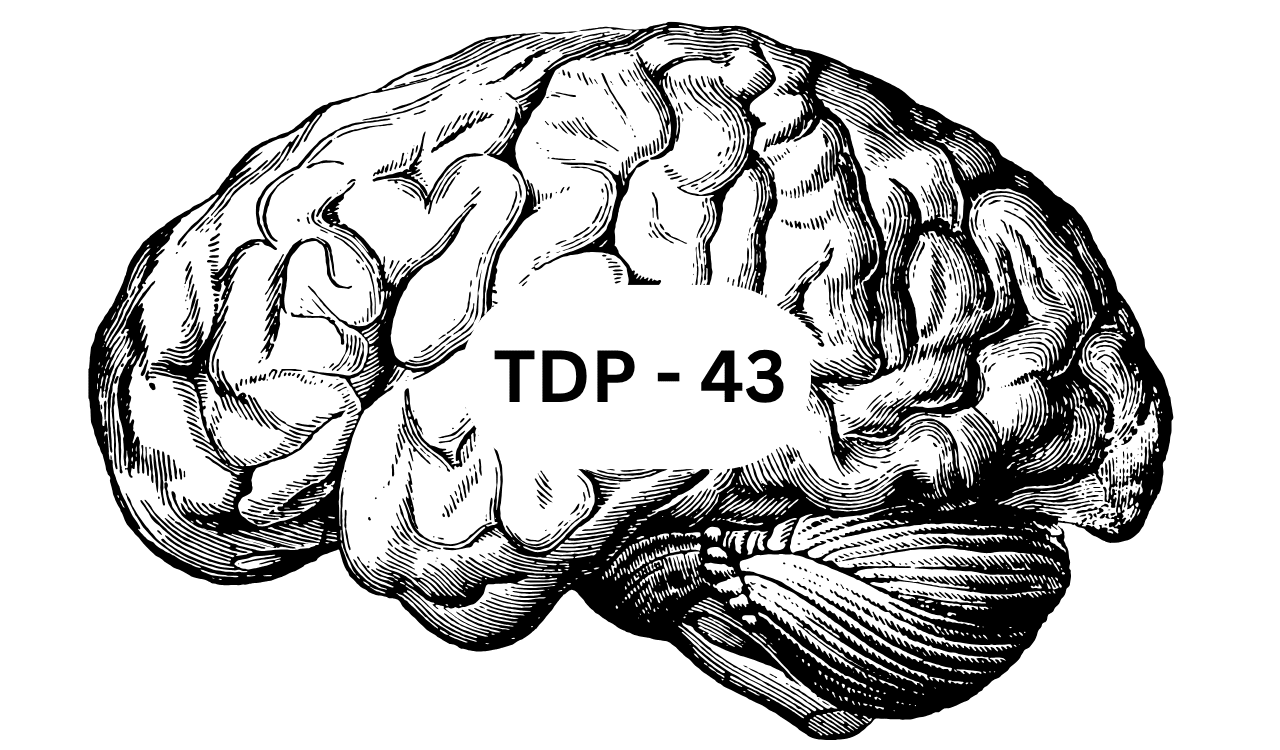
TDP-43: TAR DNA-binding protein 43, a nuclear protein that mislocalizes and aggregates in neurons in about 97% of ALS cases and in about half of FTD cases.[8] See TDP-43 proteinopathy.
FTLD-TDP: Frontotemporal lobar degeneration with TDP-43 inclusions, one of the main pathological forms of frontotemporal dementia.
LATE: Limbic-predominant age-related TDP-43 encephalopathy, a common TDP-43 pathology in older adults that causes amnestic dementia resembling Alzheimer’s disease and often co-occurs with it.[9] See LATE and mixed pathology.
Co-pathology (mixed pathology): More than one proteinopathy in the same person, for example Alzheimer’s disease with α-synuclein or TDP-43, a common source of heterogeneity in trials.
Neurofilament light (NfL): A neuron-specific structural protein released when axons are damaged; a sensitive but not disease-specific blood marker of neurodegeneration. See NfL biomarker.
GFAP: Glial fibrillary acidic protein, an astrocyte protein; elevated plasma GFAP indicates astrocyte activation, for example in Alzheimer’s disease and brain injury.
Synaptic proteins: Proteins such as neurogranin, GAP43, PSD95 and syntaxin-1 that reflect synapse integrity. See Synaptic proteins.
Akt-mTOR pathway: An insulin and growth-factor signaling pathway that regulates neuronal metabolism and survival; a target-engagement readout for metabolic CNS drugs. See AKT panel.
Samples
EDTA plasma: The liquid part of blood collected in tubes containing the anticoagulant EDTA; the most common sample for blood biomarker studies.
Serum: The liquid left after blood has clotted. Some markers differ between serum and plasma, so one sample type should be used throughout a study.
Cerebrospinal fluid (CSF): The fluid around the brain and spinal cord, collected by lumbar puncture. Close to the brain but invasive to sample repeatedly.
Pre-analytical variables: Factors before analysis, such as tube type, time to processing, centrifugation, storage temperature and freeze–thaw cycles, that can change results.
Laboratory quality and regulation
CLIA: Clinical Laboratory Improvement Amendments of 1988: U.S. federal standards, administered by CMS, for laboratories that test human specimens for diagnosis, prevention or treatment.[10]
GLP: Good Laboratory Practice, the FDA regulation (21 CFR Part 58) for nonclinical laboratory studies that support product applications.[11]
GCLP: Good Clinical Laboratory Practice, guidance that applies GLP and GCP principles to laboratories analyzing samples from clinical trials, so results are reliable and traceable.
GCP: Good Clinical Practice, the international standard for designing, conducting and reporting clinical trials.
LDT: Laboratory developed test: a test designed, validated and performed within a single laboratory rather than sold as a kit.
SOP: Standard operating procedure, a written step-by-step instruction that makes laboratory work consistent and auditable.
Assay qualification: Experiments showing an assay performs well enough (precision, sensitivity, range, stability) for its intended use.
Assay and diagnostic performance
Coefficient of variation (CV): Standard deviation divided by the mean, expressed as a percentage; the usual measure of assay precision. Within-batch (intra-assay) and between-batch (inter-assay) CVs are reported separately.
LLOQ: Lower limit of quantification, the lowest concentration an assay measures with acceptable precision and accuracy.
Sensitivity and specificity: Sensitivity is the share of people with the condition who test positive; specificity is the share without it who test negative.
AUC (ROC): Area under the receiver operating characteristic curve, a single measure of how well a test separates two groups: 0.5 is chance, 1.0 is perfect.
Concordance: Agreement between a new test and a reference method, such as a blood test against CSF SAA, PET or autopsy.
How NeuroDex measures this
NeuroDex measures neuron-derived biomarkers, including α-synuclein, TDP-43, tau and pTau, synaptic and signaling proteins, inside NDEs isolated from EDTA plasma or serum with ExoSORT™, in CLIA-certified, GCLP-aligned laboratories.
Applications by disease · Clinical trial services · Our laboratories
Frequently asked questions
What is the difference between an exosome and an extracellular vesicle?
Extracellular vesicle is the general term for membrane particles released by cells. Exosomes are one subtype that forms in the endosomal system. MISEV2023 guidelines recommend EV unless the vesicle’s origin has been shown.
What is the difference between CLIA, GLP and GCLP?
CLIA sets U.S. standards for laboratories testing human specimens for patient care. GLP is the FDA regulation for nonclinical safety studies. GCLP is guidance for laboratories analyzing clinical trial samples, combining GLP and GCP principles.
What is LATE?
Limbic-predominant age-related TDP-43 encephalopathy, a TDP-43 pathology common in people over 80 that causes memory loss resembling Alzheimer’s disease and often occurs alongside it.
What does CV mean for a biomarker assay?
The coefficient of variation is the standard deviation divided by the mean. Lower CV means better precision; acceptable limits depend on the biomarker’s context of use.
References
- FDA-NIH Biomarker Working Group. BEST (Biomarkers, EndpointS, and other Tools) Resource. 2016–.
- Welsh JA, et al. Minimal information for studies of extracellular vesicles (MISEV2023). J Extracell Vesicles. 2024;13(2):e12404. doi:10.1002/jev2.12404
- Mustapic M, Eitan E, Werner JK Jr, et al. Plasma extracellular vesicles enriched for neuronal origin. Front Neurosci. 2017;11:278. doi:10.3389/fnins.2017.00278
- U.S. Food and Drug Administration. Biomarker Qualification Program: context of use.
- AJMC. FDA clears first blood test for early detection of Alzheimer-linked amyloid plaques. May 2025.
- Jack CR Jr, et al. Revised criteria for diagnosis and staging of Alzheimer’s disease: Alzheimer’s Association Workgroup. Alzheimers Dement. 2024. doi:10.1002/alz.13859
- Siderowf A, et al. Assessment of heterogeneity among participants in the PPMI cohort using α-synuclein seed amplification. Lancet Neurol. 2023;22(5):407–417.
- Neumann M, et al. Ubiquitinated TDP-43 in frontotemporal lobar degeneration and amyotrophic lateral sclerosis. Science. 2006;314(5796):130–133. doi:10.1126/science.1134108
- Nelson PT, et al. Limbic-predominant age-related TDP-43 encephalopathy (LATE): consensus working group report. Brain. 2019;142(6):1503–1527. doi:10.1093/brain/awz099
- Centers for Medicare & Medicaid Services. Clinical Laboratory Improvement Amendments (CLIA).
- 21 CFR Part 58: Good Laboratory Practice for nonclinical laboratory studies. eCFR.
Related reading: Types of biomarkers explained · What are NDEs? · Biomarkers · NeuroDex FAQ
Leave a Reply