




Types of Biomarkers Explained: Diagnostic, Prognostic, Predictive, Pharmacodynamic and More
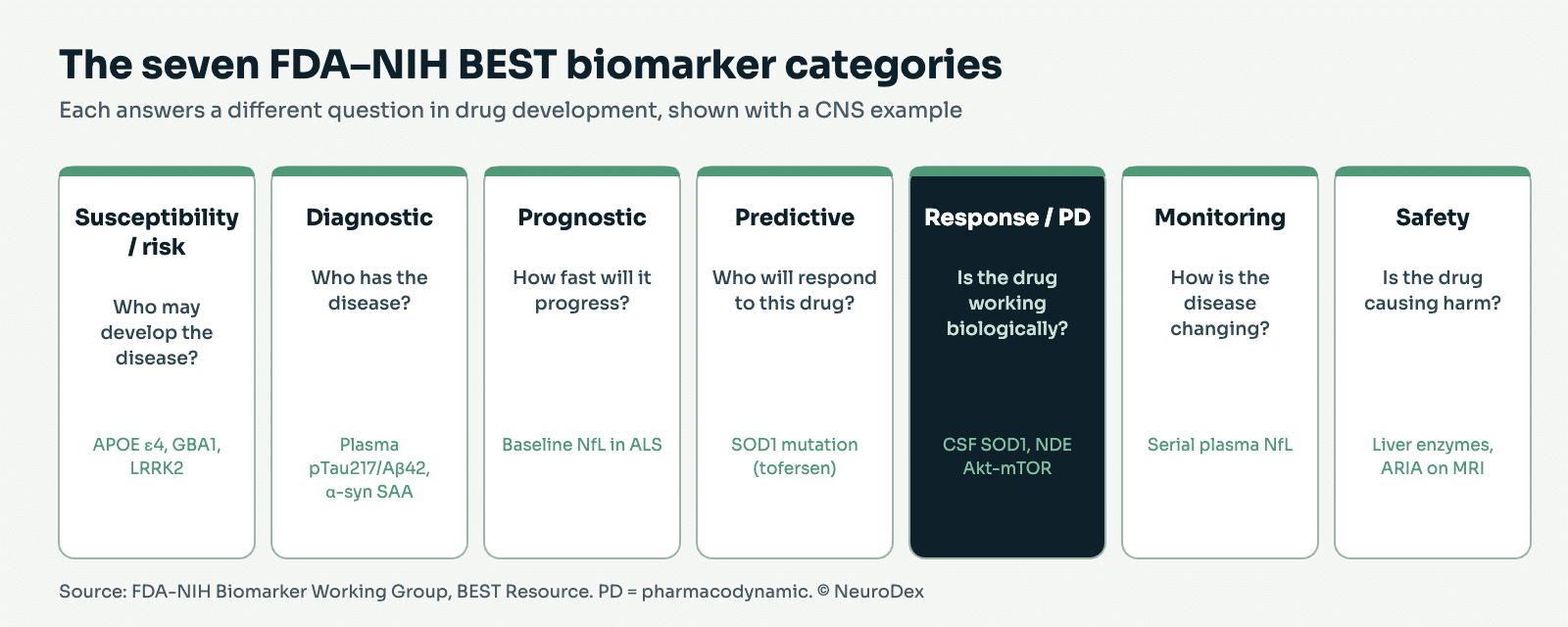
Biomarkers are grouped by what question they answer: who is at risk, who has the disease, how it will progress, who will respond to a treatment, whether the drug is working, and whether it is safe. Understanding the types of biomarkers is crucial for effective treatment. The various types of biomarkers can significantly influence therapeutic decisions. Knowing the types of biomarkers helps in tailoring treatment approaches. The U.S. Food and Drug Administration (FDA) and the National Institutes of Health (NIH) standardized these categories in the BEST (Biomarkers, EndpointS, and other Tools) resource.[1] This explainer defines each category, gives examples from neurology and CNS drug development, and explains related terms such as target engagement, surrogate endpoint and context of use.
What is a biomarker?
BEST defines a biomarker as a characteristic that is measured as an indicator of normal biological processes, disease processes, or responses to an exposure or intervention, including therapeutic interventions.[1] Biomarkers can be molecular (a protein in blood), imaging (an amyloid PET scan), physiological (blood pressure) or digital. A biomarker is not a measure of how a patient feels, functions or survives; those are clinical outcome assessments. See also Biomarkers explained.
The seven BEST biomarker categories
Understanding the Types of Biomarkers
There are many different types of biomarkers that can be classified based on their purpose and application. These types of biomarkers include diagnostic, prognostic, and predictive biomarkers, among others. Understanding these various types of biomarkers is essential for researchers and clinicians involved in drug development.
1. Susceptibility/risk biomarker
Indicates the likelihood that a person without clinically apparent disease will develop it. CNS examples: the APOE ε4 allele for Alzheimer’s disease; GBA1 and LRRK2 variants for Parkinson’s disease.
When discussing the different types of biomarkers, it’s important to recognize their roles in clinical practice and research. For instance, response biomarkers are a specific type of biomarkers that can indicate the efficacy of a treatment. All these types of biomarkers play a critical role in advancing medical care.
2. Diagnostic biomarker
Detects or confirms the presence of a disease or a disease subtype. CNS examples: the plasma pTau217/Aβ42 ratio, FDA-cleared in May 2025 to help identify amyloid pathology in symptomatic adults;[2] the CSF α-synuclein seed amplification assay (SAA) for synuclein pathology. In trials, diagnostic biomarkers are used to confirm eligibility and enrich enrollment.
3. Monitoring biomarker
Measured repeatedly to assess the status of a disease or evidence of exposure or effect of a treatment. CNS example: serial plasma neurofilament light (NfL) to track the rate of neuronal damage over time.
4. Prognostic biomarker
Identifies the likelihood of a clinical event, disease recurrence or progression in people who already have the disease, regardless of treatment. CNS example: higher baseline NfL is associated with faster progression in ALS, which is why it is used to balance or stratify trial arms.
5. Predictive biomarker
Identifies people who are more likely than similar people without the biomarker to experience a favorable or unfavorable effect from a specific treatment. CNS examples: an SOD1 mutation identifies the ALS patients for whom tofersen is indicated;[3] confirmed amyloid pathology is required before treatment with anti-amyloid antibodies in Alzheimer’s disease.
6. Response biomarker (including pharmacodynamic)
Shows that a biological response has occurred in a person exposed to a medical product. Pharmacodynamic biomarkers show the drug’s biological activity and help choose doses; some can also serve as surrogate endpoints. CNS examples: reduction of SOD1 protein in CSF with tofersen; changes in neuron-derived vesicle Akt-mTOR signaling markers after liraglutide or pioglitazone.[3][4] Learn more on our pharmacodynamic biomarkers page.
7. Safety biomarker
Measured before or after exposure to a medical product to indicate the likelihood, presence or extent of toxicity. Examples: liver enzymes for drug-induced liver injury; MRI monitoring for amyloid-related imaging abnormalities (ARIA) during anti-amyloid antibody treatment.
Prognostic vs. predictive: the most common confusion
As the field evolves, the identification of new types of biomarkers is becoming increasingly important. Researchers continue to explore various types of biomarkers, leading to more targeted and effective therapies. The discovery of additional types of biomarkers enhances our understanding of diseases and treatment responses.
A prognostic biomarker tells you how the disease is likely to behave whatever you do. A predictive biomarker tells you whether a specific treatment is likely to work. To show that a biomarker is predictive, you generally need to compare treated and untreated (or differently treated) people with and without the biomarker. A high-risk patient with a strong prognostic marker may or may not benefit more from the drug.[1]
Related terms used in CNS drug development
- Target engagement biomarker: a type of pharmacodynamic biomarker that shows the drug reached its intended target and changed it, for example receptor occupancy on PET or a change in a pathway protein measured in neurons. It answers “did the drug get there and do what it was designed to do?” See Did your GLP-1 drug reach the brain?
- Stratification (enrichment) biomarker: used to select or group trial participants, for example by pathology, genotype or rate of progression. In BEST terms these are usually diagnostic, prognostic or predictive biomarkers used for enrichment. See Beyond α-synuclein: stratifying Parkinson’s patients.
- Surrogate endpoint: a biomarker accepted as predicting clinical benefit that can substitute for a clinical outcome. BEST distinguishes validated surrogate endpoints from reasonably likely surrogate endpoints that support accelerated approval. Tofersen’s 2023 accelerated approval was based on reduced plasma NfL as a reasonably likely surrogate endpoint.[1][3]
- Context of use (COU): a concise statement of the biomarker category and exactly how it will be used in drug development. FDA evaluates biomarker evidence against a specific COU.[5]
- Analytical vs. clinical validation: analytical validation shows the assay measures the biomarker accurately and reproducibly (precision, sensitivity, range, stability); clinical validation shows the biomarker is associated with the clinical state or outcome for the intended COU. Evidence should be fit for purpose: an exploratory pharmacodynamic marker needs less than a surrogate endpoint.
How to choose biomarkers for a CNS trial
- Write down the decision the biomarker will support: enrollment, dose selection, go/no-go, or label claim.
- Map that decision to a BEST category and draft the context of use.
- Choose a matrix the trial can sample at every visit. Blood allows serial sampling that CSF and PET rarely do.
- Check analytical validation data, including within- and between-batch variability, before the first sample is shipped.
- Consider testing the biomarker on samples you already have. See Before you add a blood biomarker to your trial.
How NeuroDex measures this
NeuroDex provides target engagement, pharmacodynamic, stratification and safety biomarkers measured inside neuron-derived extracellular vesicles from blood, with assays run in CLIA-certified, GCLP-aligned laboratories. We help sponsors define the context of use and choose markers for each trial phase, from preclinical studies through phase 2b.
Pharmacodynamic biomarkers · Clinical trial services · What are NDEs?
In summary, knowing the types of biomarkers is essential for the future of personalized medicine. A comprehensive understanding of the various types of biomarkers allows healthcare providers to make informed decisions about patient care.
Frequently asked questions
What are the main types of biomarkers?
The FDA–NIH BEST resource defines seven categories: susceptibility/risk, diagnostic, monitoring, prognostic, predictive, response (including pharmacodynamic) and safety biomarkers. One biomarker can belong to more than one category depending on how it is used.
What is the difference between a prognostic and a predictive biomarker?
A prognostic biomarker estimates the likely course of disease regardless of treatment. A predictive biomarker identifies people who are more likely to respond, or respond differently, to a specific treatment.
What is a pharmacodynamic biomarker?
A pharmacodynamic (response) biomarker shows that a biological response has occurred after exposure to a drug. Target engagement biomarkers are a subset that show the drug reached and modulated its intended target.
Is a biomarker the same as a surrogate endpoint?
No. A surrogate endpoint is a biomarker that is accepted to predict clinical benefit and can stand in for a clinical outcome in a trial. Most biomarkers are never validated to that level. Tofersen received accelerated approval in SOD1-ALS based on reduced plasma neurofilament light as a reasonably likely surrogate endpoint.
What is a biomarker context of use?
The context of use is a precise statement of how a biomarker will be used in drug development, including its category and purpose. FDA evaluates validation evidence against that specific context of use.
Additionally, further education on the types of biomarkers can enhance collaboration among researchers, clinicians, and patients. The collective understanding of these types of biomarkers will lead to better outcomes in clinical research and patient care.
References
- FDA-NIH Biomarker Working Group. BEST (Biomarkers, EndpointS, and other Tools) Resource. Silver Spring (MD): Food and Drug Administration; Bethesda (MD): National Institutes of Health; 2016–.
- AJMC. FDA clears first blood test for early detection of Alzheimer-linked amyloid plaques. May 2025.
- Biogen. FDA grants accelerated approval for QALSODY™ (tofersen) for SOD1-ALS. April 2023.
- Evers A, Watson K, Abbasi F, et al. Insights from changes in NDEV biomarkers of metabolism: effects of PPARγ and GLP1 receptor agonists on brain metabolism. J Clin Endocrinol Metab. 2026. doi:10.1210/clinem/dgag176
- U.S. Food and Drug Administration. Biomarker Qualification Program: context of use.
Related reading: Glossary of CNS biomarker terms · Biomarkers explained · NfL vs. NDE biomarkers · NeuroDex FAQ
FAQs regarding the types of biomarkers can help clarify common misconceptions in the field. Many questions arise about how these types of biomarkers can be effectively utilized in clinical scenarios.
For instance, many patients wish to know how the types of biomarkers affect their treatment plans. Understanding the implications of various types of biomarkers can empower patients to engage more actively in their healthcare choices.
In conclusion, comprehending the various types of biomarkers is fundamental in the landscape of modern medicine. By focusing on the types of biomarkers, healthcare professionals can improve diagnostic precision and treatment efficacy.


Leave a Reply