




Blood biomarker for alpha-synuclein pathology, validated at autopsy
In a 1,304-person study by NeuroDex and Columbia University, alpha-synuclein in neuron-derived extracellular vesicles from plasma was elevated in Parkinson’s disease, in biomarker-positive Alzheimer’s disease, and in Lewy body pathology confirmed at autopsy.
Alpha-synuclein aggregation into Lewy bodies defines Parkinson’s disease and dementia with Lewy bodies. The same pathology appears in an estimated 30–60% of Alzheimer’s cases confirmed at autopsy, where it is linked to faster progression. Because one pathology drives conditions with very different symptoms, researchers have proposed a biological definition, neuronal alpha-synuclein disease, that groups patients by what is happening in the brain rather than by symptoms. The challenge is identifying these patients in life. CSF seed amplification assays, developed in recent years, detect the pathology accurately, but they require a lumbar puncture, which is invasive, impractical at population scale, difficult to repeat and often not feasible in patients with agitation.
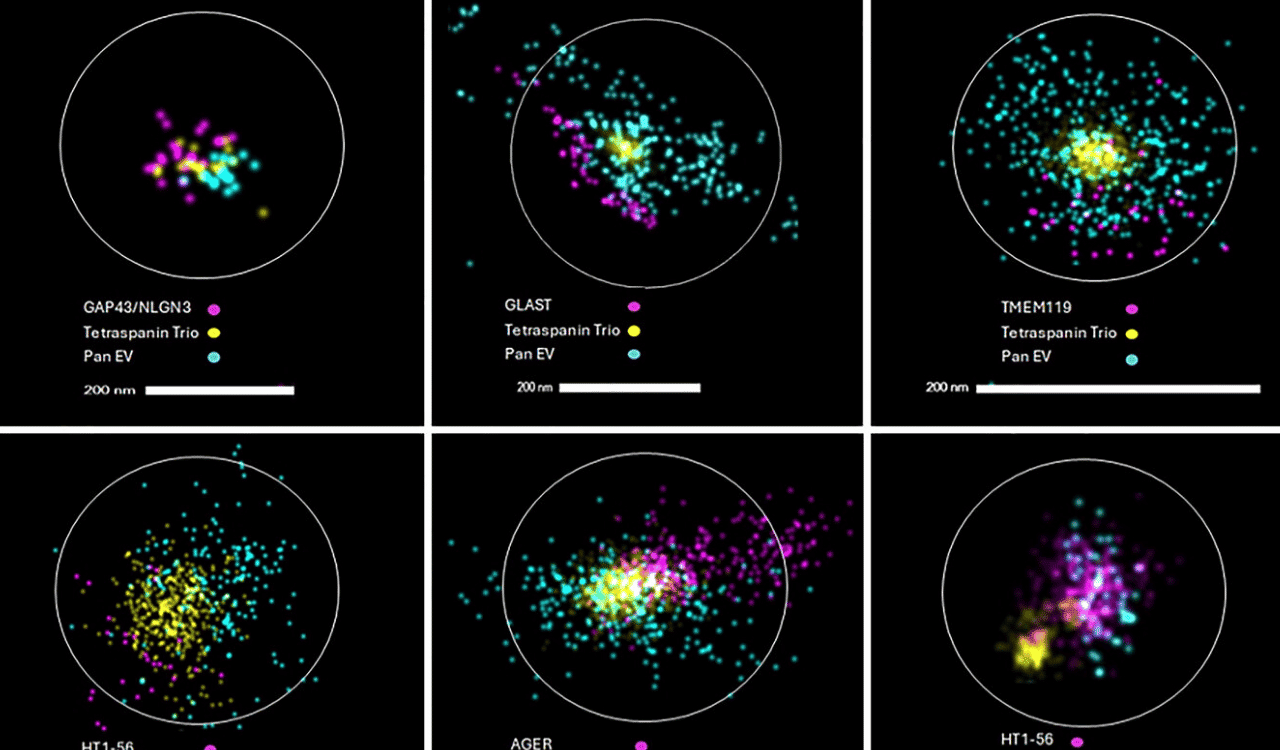
Blood has not worked as an alternative because red blood cells contain large amounts of alpha-synuclein, which swamps any brain-derived signal. NeuroDex developed ExoSORT™, an automated 96-well platform that gets around this by isolating neuron-derived extracellular vesicles (nEVs). These nano-sized vesicles, enclosed by a lipid bilayer, are released by neurons, and some cross the blood-brain barrier into circulation, carrying proteins, lipids and RNA that reflect their cell of origin. Using multiple techniques, including unbiased proteomics and RNA sequencing, NeuroDex has shown about 100-fold enrichment of neuron-specific signal. Isolating nEVs filters out non-neuronal alpha-synuclein before measurement.
Key findings
Scientists at NeuroDex and Columbia University, working with the Global Alzheimer’s Platform Foundation, measured nEV alpha-synuclein in 1,304 people across four cohorts (EFIGA, WHICAP, Bio-Hermes and PPMI): 41 with early, untreated Parkinson’s disease, 469 with Alzheimer’s disease or related dementias, and 794 without dementia. Autopsy data were available for 127 participants, 31 of whom had Lewy body pathology.
- Parkinson’s disease: Levels were 35.3% higher than in controls (P = 8.66×10⁻⁵).
- Autopsy validation: People with Lewy body pathology confirmed at postmortem had 28.6% higher levels in life than those without (P = 0.02). The authors describe this as one of the few studies to anchor a blood-based alpha-synuclein measure to neuropathology. In a small CSF seed assay subset, levels were 18.2% higher in SAA-positive individuals, a difference that did not reach significance (P = 0.15).
- Alzheimer’s co-pathology: Levels were higher in people positive for plasma P-tau181 (8.2%) and P-tau217 (7.0%), amyloid PET (5.8%), and clinical dementia (9.3%), all statistically significant.
- Early signal: Elevated levels appeared in biomarker-positive individuals before dementia onset, suggesting alpha-synuclein dysregulation may begin early in the Alzheimer’s cascade. This is relevant for trial enrichment.
- Link to neurodegeneration: Among people with Alzheimer’s dementia, higher levels correlated with smaller hippocampal volume on MRI (r = −0.23, P = 0.04).
- Positivity threshold: A blood cut-score (AUC 0.78) classified 64.7% of autopsy-confirmed Lewy body cases and 66.7% of SAA-positive individuals as alpha-synuclein-positive. It also flagged 46% of P-tau181-positive individuals, consistent with prior neuropathology studies.
Why it matters for drug development
Lewy body co-pathology affects prognosis, treatment response and eligibility for alpha-synuclein-targeting therapies, yet it goes largely undetected in trials screened with amyloid and tau biomarkers. It is often missed in the clinic too: in a national autopsy study, fewer than half of people with Lewy body disease were correctly diagnosed in life, most often being told they had Alzheimer’s. That means an inaccurate prognosis and a treatment plan that may not fit the disease.
The gap carries into drug development. About one million Americans live with Parkinson’s disease and an estimated 1.4 million with Lewy body dementia, a spectrum that includes Parkinson’s disease dementia. Yet ClinicalTrials.gov lists 166 active Parkinson’s trials and only 7 in Lewy body disease, and difficulty finding the right patients is likely a large part of the reason. A repeatable blood measure of brain-derived alpha-synuclein could support patient stratification and longitudinal monitoring at a scale lumbar puncture cannot, for treatment decisions and for drug development in these devastating conditions.
Limitations include the study’s cross-sectional design, a modest number of Lewy body–positive autopsy cases, and a small CSF subset. Longitudinal studies and larger postmortem cohorts are needed to confirm the findings and to test whether nEV alpha-synuclein tracks disease progression over time.
The study was supported by the Alzheimer’s Drug Discovery Foundation Diagnostics Accelerator, The Michael J. Fox Foundation, and NINDS grant R44NS130864. Cohort data collection was funded by the National Institute on Aging and the National Institutes of Health.
Publication: Gunasekaran TI, Reyes-Dumeyer D, Gu Y, et al. Antemortem α-Synuclein levels from neuron-derived extracellular vesicles identify Lewy Body pathology in Parkinson’s Disease and Alzheimer Disease. medRxiv. Posted August 5, 2026. https://doi.org/10.64898/2026.08.03.26359636
This preprint reports research that has not been certified by peer review and should not be used to guide clinical practice. Two authors are employees of NeuroDex, and Dr. Eitan holds stock in the company.


Leave a Reply