



NeuroDex Publishes Validated Workflow for Isolating Tissue-Specific Extracellular Vesicles From Blood
Peer-reviewed study in the Journal of Extracellular Biology extends the company's plasma EV platform beyond the brain to lung and liver, opening new paths for liquid biopsy and biomarker discovery.
Boston, MA — July 2026
NeuroDex today announced the publication of a peer-reviewed study in the Journal of Extracellular Biology, the official journal of the International Society for Extracellular Vesicles (ISEV), demonstrating a validated method for enriching tissue-specific extracellular vesicles (EVs) directly from human blood plasma.
Extracellular vesicles carry molecular information from the cells that release them, making them a promising window into the health or disease state of specific tissues — without the need for an invasive biopsy. But reliably separating the EVs that come from one tissue, out of the vast mixture circulating in blood, has been a persistent technical challenge.
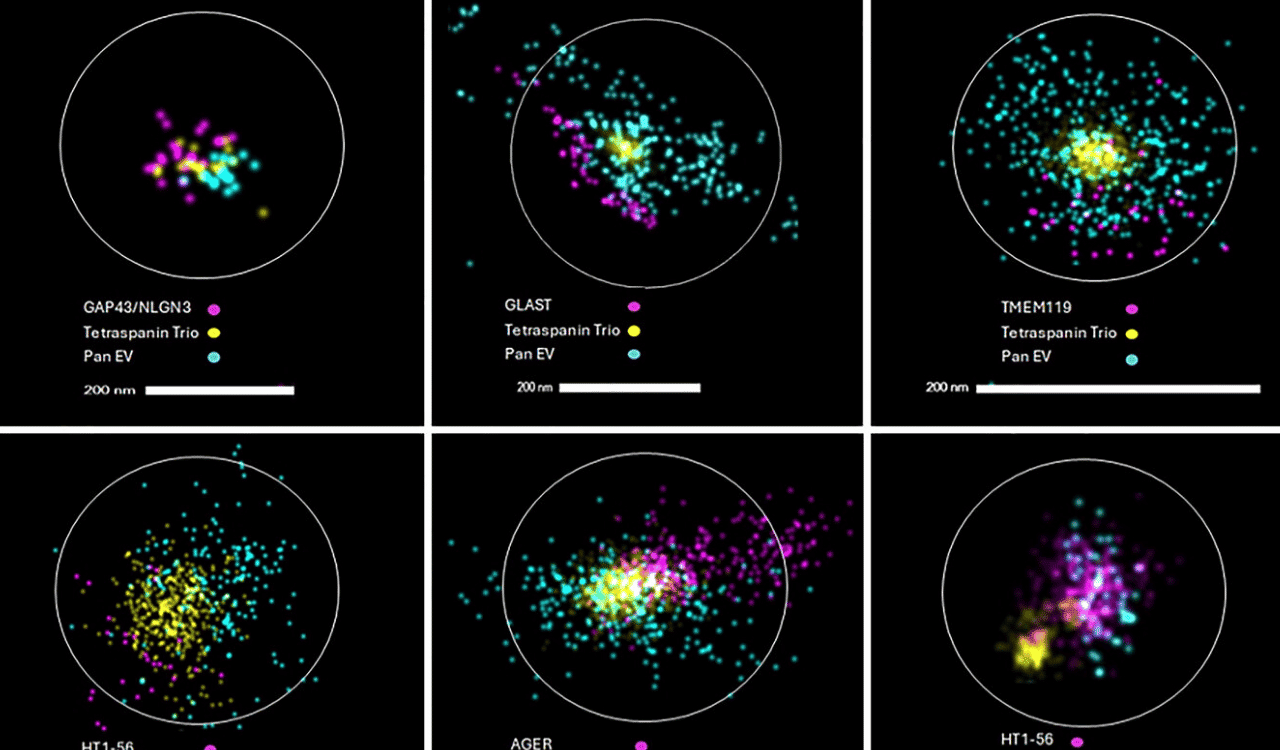
The new study, conducted with collaborators at Johns Hopkins University, Columbia University’s Mailman School of Public Health, the Harvard T.H. Chan School of Public Health, and the University of California San Diego, describes single and sequential immunoaffinity capture workflows that enrich antigen-specific EV subpopulations from plasma. The authors demonstrate the specificity, efficiency, and consistency of the approach across three tissue sources: the nervous system, lung alveolar cells, and hepatocytes.
Critically, the enriched vesicles were confirmed using canonical EV features and markers, and the work showed co-localization of tissue-specific and general markers on the vesicle surface — evidence that the captured populations are both genuine EVs and genuinely tissue-specific.
“This work shows that a single blood draw can yield multiple, well-characterized EV subpopulations tied to specific organs,” said Erez Eitan of NeuroDex, a co-author on the study. “It’s the foundation for biomarker discovery and liquid biopsy that reaches beyond the brain — where we started — into a much broader range of diseases.”
For NeuroDex, the study is an important validation milestone. The company’s technology was built to isolate neuron-derived vesicles from plasma to support blood-based diagnostics for Alzheimer’s disease, Parkinson’s disease, Lewy body dementia, ALS, and other neurodegenerative conditions. Demonstrating the same rigorous capture for lung and liver EVs signals a platform that can support biomarker programs across organ systems.
The paper is open access and available at doi.org/10.1002/jex2.70171.
NeuroDex works with academic and industry partners on biomarker discovery and blood-based assays. Teams interested in accessing tissue-specific EVs from plasma for research or clinical development can contact the company through neurodex.co.
Why tissue-specificity is the hard part
Blood is one of the most information-rich samples in medicine, but also one of the most crowded. A single plasma draw contains extracellular vesicles shed by nearly every tissue in the body, mixed together with abundant proteins and lipoproteins of similar size and density. Conventional isolation methods can concentrate vesicles as a bulk population, but they cannot tell you which organ a given vesicle came from. That ambiguity has limited how confidently researchers can attribute a molecular signal to a specific tissue — and it is precisely the gap this study addresses. By using antibodies against surface antigens characteristic of a target cell type, immunoaffinity capture pulls out the vesicles that matter and leaves the rest behind. The study’s sequential capture design goes a step further, showing that more than one tissue-specific subpopulation can be recovered in a defined order from the same starting sample, making the most of every milliliter of blood.
What it enables for drug developers and diagnostics
For biopharma teams, a reliable source of organ-specific vesicles opens several practical avenues. In neurodegeneration, where NeuroDex’s technology originated, brain-derived vesicles offer a minimally invasive route to pharmacodynamic and target-engagement biomarkers that would otherwise require cerebrospinal fluid or imaging. Extending the same rigor to lung and liver vesicles suggests analogous opportunities in respiratory, hepatic, and metabolic disease — areas where tissue access is difficult and where better circulating biomarkers could sharpen patient selection, stratification, and response monitoring in clinical trials. For diagnostics developers, tissue-specific enrichment provides a cleaner substrate for discovering and validating markers of early disease, before symptoms or structural damage appear. Because the workflow starts from standard plasma, it fits into existing sample-collection infrastructure rather than requiring new procedures at the point of care.
About NeuroDex
NeuroDex is developing a suite of blood-based biomarkers and enabling technologies to accelerate the development of tests and therapies for neurodegenerative disease. Its platform isolates cell-specific extracellular vesicles (exosomes) from plasma and detects protein markers of disease within or on the surface of those vesicles.
Citation
Pierri B, Jackson GL, Gololobova O, Wang F, Eitan E, Volpert O, Kalia V, Reyes-Soffer G, Laurent LC, Witwer KW, Baccarelli AA, Wu H. Immunoaffinity-Based Protocol to Enrich Nervous System Cell–, Lung Alveolar Cell–, and Hepatocyte-Derived Extracellular Vesicles From Human Plasma. J Extracell Biol. 2026;5(7):e70171. doi:10.1002/jex2.70171

Leave a Reply