



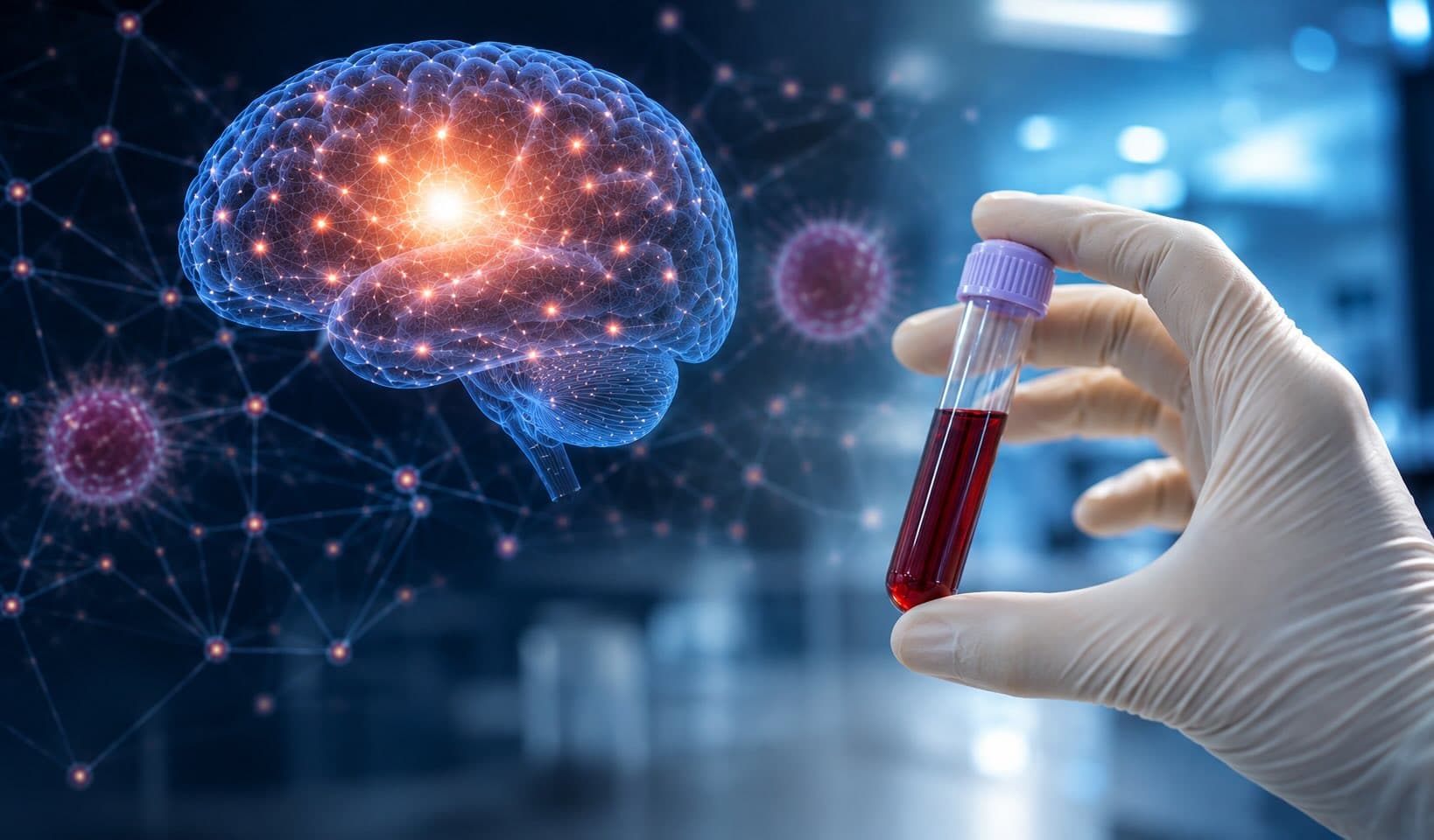
Measuring CNS Target Engagement Without a Spinal Tap
CNS target engagement
Key Takeaways
- Lumbar puncture is safe on average, but its logistics — not its risk profile — cap how many CSF timepoints a CNS trial can realistically collect.
- Most CNS trials rely on two or three CSF draws total, which forces sponsors into baseline/endpoint snapshots instead of tracking a treatment response as it unfolds.
- Neuron-derived extracellular vesicles (NDEVs), enriched from a standard blood draw, give trial teams a repeatable route to neuronal biology without adding lumbar puncture visits.
- NDEV data should complement, not replace, CSF and imaging — the opportunity is more sampling timepoints, not a wholesale swap of modalities.
Ask a clinical operations lead running a Phase II CNS trial what keeps them up at night, and lumbar puncture logistics is a common answer. Not because the procedure is unsafe — it isn’t, in most populations — but because every additional CSF draw adds a protocol amendment, a site capacity constraint, and a patient who has to decide whether they’re willing to do this again next month.
That constraint shapes trial design more than most sponsors would like. It’s the reason so many CNS programs settle for a baseline sample and an endpoint sample, then try to infer everything that happened between them — and it’s a constraint that has very little to do with whether lumbar puncture is actually dangerous. The safety data are, on the whole, reassuring. The scheduling math is not.
How many CSF timepoints can a CNS trial realistically collect?
Most CNS trials collect CSF at two to four points across the entire study — often just baseline and endpoint. Multi-cohort lumbar puncture safety data put per-procedure adverse event rates at roughly 12% to 28%, mostly headache and back pain, which is why protocols rarely ask for more than a handful of draws per participant. [1–4]
That’s not a criticism of CSF. Cerebrospinal fluid remains one of the most information-dense compartments available to CNS researchers, and multiple safety studies have found lumbar puncture well tolerated across Huntington’s, Parkinson’s, and Alzheimer’s cohorts, with serious complications rare. [1–4] One large individual-patient meta-analysis across nearly 500 participants and almost 700 procedures found no significant difference in adverse event rates between manifest and premanifest Huntington’s disease groups after adjusting for age and sex — reassuring evidence that the procedure itself isn’t the bottleneck. [1]
The issue is frequency, not safety. A drug that works on a fast pharmacodynamic timescale, or one whose effect fluctuates with dosing, is nearly invisible to a trial design built around two data points three months apart. Even when a protocol is willing to fund additional CSF visits, site capacity and participant tolerance for repeated procedures set a practical ceiling well before the safety data would. Younger participants, who dominate enrollment in many ALS and early-onset movement disorder trials, also report modestly higher adverse event rates than older cohorts, adding another reason sponsors keep the CSF schedule conservative. [1]
The Two-Timepoint Problem in Pharmacodynamic Trials
Consider what a sponsor actually needs to know during a Phase Ib/IIa CNS trial: Did the drug reach the intended biology? How fast? Does the effect hold, fade, or rebound between doses? Is there a dose-response relationship worth carrying into Phase II?
Answering any of those questions from a baseline/endpoint CSF pair requires assuming the trajectory between the two points was a straight line. It usually wasn’t.
Repeated CSF sampling protocols exist — indwelling lumbar catheters have been used in select mechanistic studies to capture serial samples over hours — but they carry a materially different risk profile than a single outpatient lumbar puncture, including headache, catheter-site pain, and rare but serious complications such as epidural hematoma or infection. [5] That approach works for short, intensive proof-of-mechanism studies. It doesn’t scale to a multi-month, multi-site Phase II trial where sponsors want repeated readouts across the whole treatment course, not just a single dosing day.
Blood collection doesn’t have this ceiling. A venipuncture is a five-minute outpatient procedure with a lower reported complication rate than lumbar puncture in comparable research cohorts. [2] Sponsors can build in monthly or even weekly draws without the site-capacity and patient-burden math that constrains CSF collection.
The obstacle has never been willingness to draw more blood. It’s that blood, on its own, doesn’t tell you much about the brain — most of what circulates in plasma originates from liver, muscle, immune cells, and other peripheral tissue, which is exactly the noise problem behind plasma NfL variability and the broader skepticism around blood-based CNS biomarkers.
Picture a small-molecule program with a plasma half-life of roughly 12 hours and a hypothesized target-engagement window that peaks a few hours after dosing and fades by the next day. A two-timepoint CSF design — pre-dose and week 12 — cannot resolve that curve at all. It can only confirm that something changed over three months, with no way to attribute the change to a specific dose, a specific day, or a specific mechanism. A sampling strategy that can be repeated weekly, without adding a lumbar puncture visit each time, is the difference between a trial that can answer “does this drug engage its target” and one that can answer “when, how much, and for how long.”
Neuron-Derived EVs as a Route Around the Sampling Ceiling
Extracellular vesicles (EVs) are small, membrane-bound particles that cells across the body release into circulation, carrying protein, RNA, and other cargo that reflects their cell of origin. Neurons release them too, and a fraction of neuron-derived EVs cross the blood-brain barrier and enter peripheral blood. [6]
That’s the premise NeuroDex’s ExoSORT™ platform is built on: enrich the neuron-associated EV population out of plasma’s heterogeneous background, then measure disease-relevant cargo — proteins like α-synuclein, TDP-43, and tau-related species — within that enriched fraction rather than in whole plasma. Enrichment matters because unfractionated plasma dilutes a CNS-specific signal in an ocean of non-neuronal material; concentrating on the neuron-derived fraction is what makes the measurement CNS-relevant rather than just blood-based.
This isn’t a hypothetical workflow. Immunoaffinity-based neuron-derived EV isolation has been used to track exosomal pathway biomarkers longitudinally in an interventional Parkinson’s disease trial, where researchers followed brain insulin-signaling changes across 48 and 60 weeks of treatment from repeated blood draws — the kind of multi-timepoint pharmacodynamic readout that a CSF-only design would have struggled to deliver at that frequency. [7] A separate longitudinal cohort tracked neuron-derived EV biomarkers across nearly 900 plasma samples collected over multiple years, demonstrating that the approach holds up as a repeated-measures tool rather than a single-draw novelty. [8]
Blood collection → NDEV enrichment → target-specific cargo measurement → repeated across the treatment course
That last arrow is the whole point. A workflow that supports weekly or monthly sampling changes what a trial can ask. Instead of “did the biology change between baseline and week 12,” a sponsor can ask “when did it change, how fast, and did it hold.”
It also changes what a sponsor can do with a small early-phase cohort. A dozen participants sampled twice give a trial team two data points each — not enough to distinguish a real pharmacodynamic effect from noise. The same dozen participants sampled monthly across a six-month study give a trial team a trajectory for each person, which supports far more confident go/no-go decisions with the same enrollment number. That’s a meaningful difference for a sponsor trying to make an internal investment decision on limited Phase Ib data before committing to a larger, more expensive trial.
CSF vs. Blood-Based NDEV Sampling: What Actually Differs
| CSF (Lumbar Puncture) | Plasma NDEV Enrichment | |
|---|---|---|
| Typical timepoints/trial | 2–4 | Monthly or more feasible |
| Procedure setting | Outpatient, needs trained proceduralist | Standard blood draw |
| Reported AE rate* | ~12–28% (mostly headache, back pain) | Comparable to routine venipuncture (~3–7%) |
| Repeat-visit burden | High — separate visit, recovery time advised | Low — can pair with existing study visits |
| Analyte access | Broad CNS proteome/metabolome directly | Neuron-enriched fraction; requires enrichment step |
| Best suited for | Deep, infrequent CNS characterization | Frequent pharmacodynamic tracking over time |
*AE = adverse event. CSF rates drawn from multi-cohort lumbar puncture safety studies; NDEV/venipuncture rate from comparative safety data in the same literature. [1–4]
Neither column is “better” in the abstract — they answer different questions. CSF gives direct access to a wide CNS-relevant proteome in a single sample. NDEV enrichment trades some of that breadth for the ability to repeat the measurement often enough to see a trajectory.
Where This Matters Most: Trials With a Fast or Fluctuating PD Signal
Not every program needs six timepoints. A trial testing a disease-modifying therapy with a slow-moving biological readout may be well served by the traditional baseline/endpoint design.
The calculus changes for:
- Target engagement studies, where sponsors need to confirm the drug reached and affected the intended pathway before committing to a larger, more expensive trial. Regulatory reviewers increasingly expect this kind of mechanistic evidence ahead of a pivotal Phase II/III commitment, and a two-timepoint CSF design often can’t produce it convincingly.
- Dose-finding studies, where the pharmacodynamic response at different doses needs to be compared across a real timecourse, not two disconnected snapshots. A dose-response curve built from two points per participant is really just a line; the same curve built from six or eight points can show whether the relationship is linear, saturating, or something else entirely.
- ASO and small-molecule programs with known pharmacokinetic half-lives, where a biomarker that can be sampled on a matching schedule tells a much more complete mechanistic story than one that can’t. Programs using intrathecal antisense delivery, in particular, already accept some lumbar puncture burden for drug administration — but layering additional CSF sampling visits on top of dosing visits compounds the burden problem rather than solving it.
- Adaptive and go/no-go trial designs, where an early biomarker signal informs whether to expand a cohort, adjust a dose, or stop a program. These designs depend on having an interim readout available on a timeline the sponsor controls, not one dictated by how many lumbar punctures a protocol amendment will bear.
In each case, the limiting factor isn’t whether the biology is measurable — often it is, in both CSF and blood. The limiting factor is whether the trial design can afford to measure it often enough to matter.
What NDEV Sampling Doesn’t Solve
This isn’t a case for abandoning CSF or imaging. NDEV enrichment methods carry their own open questions — cross-laboratory reproducibility, choice and validation of enrichment strategy, and normalization approaches are all active areas of methods development, and studies have specifically flagged the need for rigorous analytical validation before any single neuron-derived EV biomarker is treated as clinically established. [9] A nested case-control study that measured amyloid, tau, and exploratory markers in parallel plasma and NDEV samples over more than three years of follow-up found that the two biofluids showed distinct biomarker signatures with little direct correlation between them — a useful reminder that NDEV measurements are not simply a lower-burden proxy for whatever plasma or CSF would show, but a genuinely different window into neuronal biology, with its own validation requirements. [9]
A trial that needs deep, single-timepoint CNS characterization — say, a full biomarker panel at screening to confirm eligibility — is still better served by CSF or imaging. And any sponsor evaluating an NDEV-based endpoint for a regulatory submission should expect to generate its own analytical validation package: precision, reproducibility across sites, and a defined normalization approach, rather than assuming published feasibility data transfers directly to a new assay or a new patient population.
The realistic picture is additive: CSF and imaging for depth at a few critical timepoints, NDEV-based blood sampling for frequency across the ones in between. A trial that pairs a baseline and endpoint lumbar puncture with monthly NDEV blood draws gets both the deep characterization and the trajectory — something neither modality delivers alone.
The Direction This Is Heading
Sponsors are increasingly asking not just “can we detect this biomarker” but “can we detect it often enough to build a dose-response curve, a time-to-effect estimate, or an early stop/go signal.” That’s a sampling-frequency question as much as a sensitivity question, and it’s one CSF-centric designs structurally struggle to answer.
As NDEV isolation methods mature and reproducibility data accumulates across labs, blood-based pharmacodynamic monitoring is likely to become a standard companion to — not a replacement for — CSF and imaging in CNS trial design. The programs that adopt it early get a trial design advantage: more data points, drawn from a procedure patients are far more willing to repeat.
That last point is worth sitting with. A trial protocol can specify as many sampling timepoints as a sponsor wants on paper. What actually determines the real-world sampling frequency is whether participants show up for the visit. Retention data across long-running CSF collection initiatives shows participants are generally willing to return for planned research lumbar punctures, but “willing” and “eager” are different things — and a procedure that can be scheduled alongside a routine clinic visit, rather than one that requires a dedicated appointment, a recovery period, and advance planning, tends to see better long-term adherence across a multi-year trial.
For sponsors evaluating how a neuron-derived EV workflow would fit into an existing trial design, NeuroDex’s ExoSORT™ platform is built specifically around that repeated-sampling use case — more at neurodex.co.
References
- Hassan YR, Rodrigues FB, Zeun P, et al. Lumbar puncture safety and tolerability in premanifest and manifest Huntington’s disease: a multi-analysis cross-sectional study. Sci Rep. 2022;12:18377. doi:10.1038/s41598-022-21934-6
- Moulder KL, Snider BJ, Mills SL, et al. Factors influencing successful lumbar puncture in Alzheimer research. Alzheimer Dis Assoc Disord. 2017;31(4):287-294. doi:10.1097/WAD.0000000000000209
- Prakash N, Hendricks A, Fritz N, et al. Feasibility and safety of lumbar puncture in the Parkinson’s disease research participants: Parkinson’s Progression Marker Initiative (PPMI). Parkinsonism Relat Disord.2019;62:201-209. doi:10.1016/j.parkreldis.2018.12.025
- Duits FH, Martinez-Lage P, Paquet C, et al. Performance and complications of lumbar puncture in memory clinics: results of the multicenter lumbar puncture feasibility study. Alzheimers Dement. 2016;12(2):154-163. doi:10.1016/j.jalz.2015.08.003
- A Study in Healthy Men to Test How Different Doses of BI 474121 Are Taken Up… [clinical trial protocol documenting serial CSF sampling via indwelling spinal catheter and associated procedural risks]. ClinicalTrials.gov NCT04672954.
- Van Niel G, D’Angelo G, Raposo G. Shedding light on the cell biology of extracellular vesicles. Nat Rev Mol Cell Biol. 2018;19(4):213-228. doi:10.1038/nrm.2017.125
- Athauda D, Gulyani S, Karnati HK, et al. Utility of neuronal-derived exosomes to examine molecular mechanisms that affect motor function in patients with Parkinson disease: a secondary analysis of the Exenatide-PD trial. JAMA Neurol. 2019;76(4):420-429. doi:10.1001/jamaneurol.2018.4304
- Kapogiannis D, Mustapic M, Shardell MD, et al. Association of extracellular vesicle biomarkers with Alzheimer disease in the Baltimore Longitudinal Study of Aging. JAMA Neurol. 2019;76(11):1340-1351. doi:10.1001/jamaneurol.2019.2462
- Manolopoulos A, Delgado-Peraza F, Mustapic M, et al. Comparative assessment of Alzheimer’s disease-related biomarkers in plasma and neuron-derived extracellular vesicles: a nested case-control study. Front Mol Biosci. 2023;10:1254834. doi:10.3389/fmolb.2023.1254834


Leave a Reply