




What Is a Blood Test for Alzheimer’s? A Complete 2026 Guide
Last updated: July 2026 · Reviewed for accuracy against FDA, Mayo Clinic, and Alzheimer’s Association sources
What Is a Blood Test for Alzheimer’s?
The Biology Behind the Test: Amyloid and Tau
Which Biomarkers Do Blood Tests Measure?
Not all Alzheimer’s blood tests are the same. Different assays measure different proteins, and each tells a slightly different part of the story. These are the biomarkers you are most likely to encounter:
p-tau217 (phosphorylated tau 217)
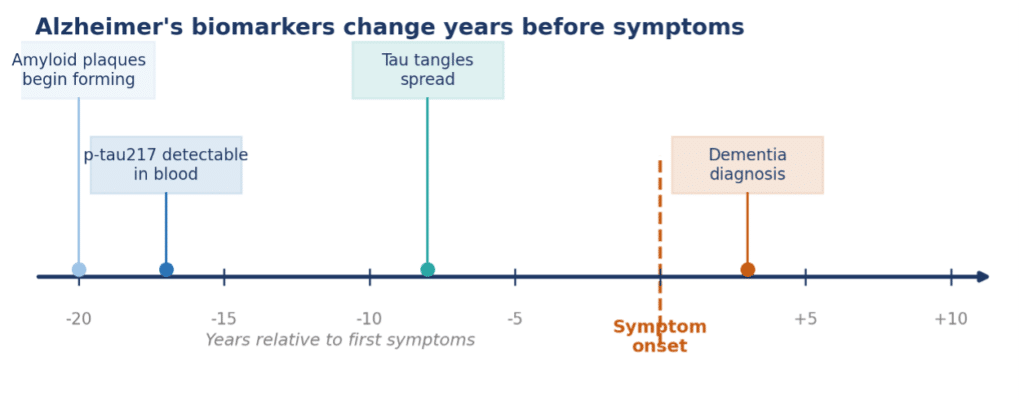
p-tau217 is the standout performer and the biomarker at the heart of the first FDA-cleared test. Levels of p-tau217 rise in step with both amyloid and tau brain changes, so it broadly reflects core Alzheimer’s pathology. Studies report that p-tau217 achieves area-under-the-curve (AUC) values above 0.93 for detecting Alzheimer’s pathology and can flag changes 15 to 20 years before symptoms begin. Among all blood markers, it currently offers the best single-test accuracy.
Beta-amyloid 42/40 ratio (Aβ42/40)
This test compares two forms of amyloid protein. A lower Aβ42/40 ratio in blood signals that more amyloid is being deposited as plaques in the brain rather than circulating freely. It served as one of the earliest blood surrogates for cerebral amyloid burden and is often combined with p-tau217 for a fuller picture—the approach used by the FDA-cleared Lumipulse test.
p-tau181
A close relative of p-tau217, p-tau181 also rises with Alzheimer’s pathology. It is slightly less discriminating than p-tau217 but is well validated and is the marker used in the second FDA-cleared test, designed for primary-care rule-out.
GFAP (glial fibrillary acidic protein)
GFAP is a marker of astrocyte activation and neuroinflammation. It tends to be elevated in amyloid-positive individuals and can help clarify the cause of cognitive symptoms, especially when combined with other markers.
NfL (neurofilament light chain)
NfL is a general marker of nerve-cell damage. It is not specific to Alzheimer’s—it rises in many neurological conditions—but it is useful for confirming that neurodegeneration is occurring and for tracking its intensity over time.
Used together, these markers are more powerful than any one alone. Multimarker panels combining p-tau217, GFAP, NfL, and the Aβ42/40 ratio can push diagnostic accuracy to an AUC of roughly 0.97, according to the same 2025 biomarker review. You can compare specific panels in our guide to Alzheimer’s biomarker testing.
How Does a Blood Test for Alzheimer’s Work?
From the patient’s perspective, the process is simple—no different from any routine blood draw. Behind the scenes, however, sophisticated chemistry is at work. The typical steps are:
- A standard blood draw. A phlebotomist collects a small sample from a vein in the arm.
- Ultra-sensitive measurement. The laboratory uses highly sensitive immunoassays to detect proteins present at extremely low concentrations—often thousands of times lower than in cerebrospinal fluid.
- Ratio calculation. Many tests report a ratio (for example, p-tau217 divided by Aβ42) rather than a single value, because ratios are more robust and correlate better with brain imaging.
- Interpretation against a threshold. The result is compared to validated cut-offs and reported as positive, negative, or intermediate for Alzheimer’s pathology.
The results are then read alongside a clinical exam, cognitive testing, and medical history. Because a blood result is one input among several, it belongs within a broader cognitive assessment workflow rather than replacing it.
FDA-Cleared Alzheimer’s Blood Tests
Two blood tests have now cleared the FDA’s bar for clinical use, and several more are available as laboratory-developed tests through national labs.
Fujirebio Lumipulse G p-tau217/β-Amyloid 1-42 (May 2025)
On May 16, 2025, the FDA granted its first-ever clearance for a blood test to help diagnose Alzheimer’s. The Lumipulse G p-tau217/β-Amyloid 1-42 Plasma Ratio is cleared for symptomatic adults aged 55 and older who are being evaluated for cognitive decline. It measures both p-tau217 and beta-amyloid 1-42 and reports their ratio, which correlates with the presence or absence of amyloid plaques. In validation studies, the test showed 91.7% agreement with amyloid PET or spinal-fluid results for positive cases and 97.3% agreement for negative cases.
Roche Elecsys p-tau181 (October 2025)
In October 2025, the FDA cleared a second test—Roche’s Elecsys p-tau181 plasma assay—intended for primary-care settings to help rule out Alzheimer’s-related amyloid pathology in adults 55 and older with cognitive symptoms. Its clearance is significant because it moves biomarker testing beyond specialist clinics and closer to where many patients are first evaluated.
Tests available through national laboratories
Beyond FDA-cleared devices, both Labcorp and Quest Diagnostics offer a menu of Alzheimer’s blood tests. Labcorp measures markers including p-tau181, p-tau217, GFAP, NfL, and the Aβ42/40 ratio, while Quest offers several tests under its AD-Detect name. Availability and ordering rules vary, so it is worth confirming details with your clinician.
How Accurate Is a Blood Test for Alzheimer’s?
Accuracy is the question that matters most—and the honest answer is “very good, but context-dependent.” As a stand-alone test, plasma p-tau217 has been reported to reach an overall accuracy of about 81%, with a positive predictive value near 79%, according to a study of plasma p-tau217/Aβ42 across clinical and community cohorts. When a positive blood result is confirmed with a follow-up PET scan, accuracy climbs to roughly 91%.
The FDA-cleared Lumipulse test performs even better in its intended population, with concordance above 90% against gold-standard PET and spinal-fluid tests. Research published on a fully automated p-tau217 platform likewise found strong performance in both primary and secondary care, supporting the shift toward routine clinical use.
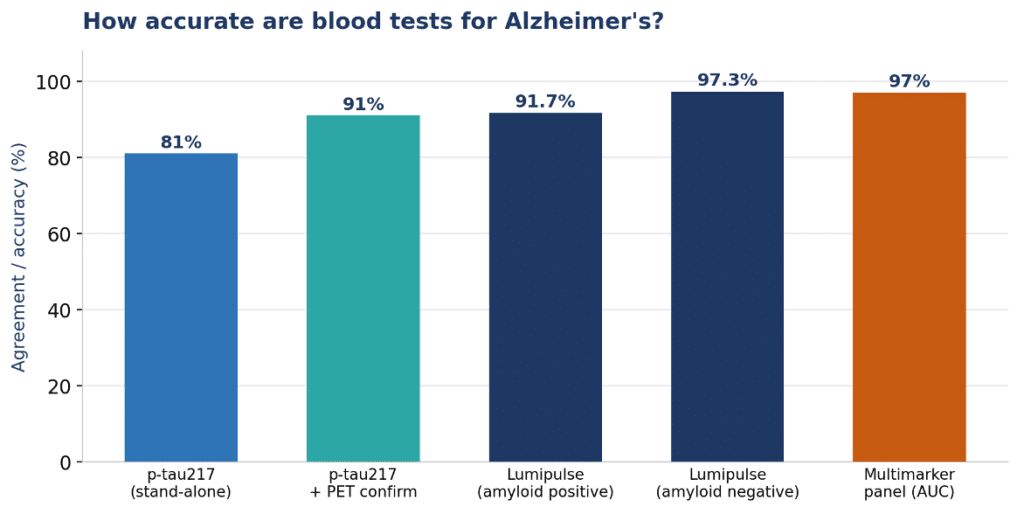
Figure 2. Reported agreement and accuracy across common blood-based tests. Confirming a positive result with PET raises overall accuracy, and multimarker panels perform best.
In July 2025 the Alzheimer’s Association issued its first clinical practice guideline for blood-based biomarker tests. It set performance-based thresholds rather than endorsing specific brands. The full guideline in Alzheimer’s & Dementia recommends that a test with at least 90% sensitivity and 75% specificity may be used to triage patients, while a test reaching 90% sensitivity and 90% specificity can substitute for a PET scan or spinal tap in specialist care.
Who Should Get a Blood Test for Alzheimer’s?
The FDA-cleared tests are intended for adults 55 and older who already have symptoms of cognitive decline—memory loss, confusion, or difficulty with everyday tasks—and who are being evaluated by a clinician. In this setting the test can speed up diagnosis, reduce uncertainty, and help determine eligibility for new treatments.
It is equally important to understand who should not rush to be tested:
- People with no symptoms. The tests are not approved or recommended for screening healthy, asymptomatic individuals. A positive result in someone without symptoms cannot reliably predict if or when they will develop dementia.
- People seeking a definitive answer without follow-up. A blood test is a starting point, not a verdict. Positive results typically warrant confirmatory testing before any diagnosis or treatment.
The Mayo Clinic notes that while these tests are a major advance, they are meant to be used as part of a full clinical evaluation. If you are weighing whether testing is right for you or a family member, our article on deciding whether to get tested for Alzheimer’swalks through the key considerations.
Blood Test vs. PET Scan vs. Spinal Tap
Until recently, confirming Alzheimer’s pathology required one of two demanding procedures. Here is how the blood test compares:
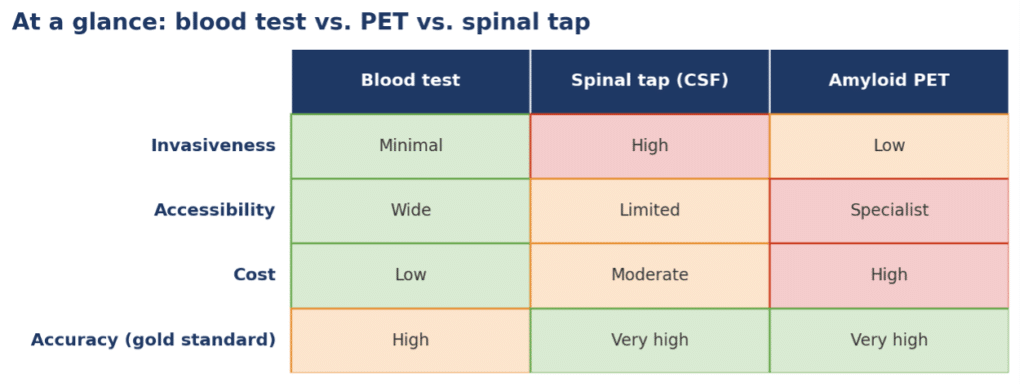
Figure 3. Blood tests trade a small amount of stand-alone certainty for major gains in convenience, access, and cost.
- • Amyloid PET scan: Highly accurate and considered a gold standard, but expensive (often several thousand dollars), involves a radioactive tracer, and is not available everywhere.
- • Cerebrospinal fluid (spinal tap): Also highly accurate, but invasive—it requires inserting a needle into the lower spine to collect fluid, which deters many patients.
- • Blood test: Minimally invasive, low-cost, fast, and widely accessible. Slightly less definitive alone, but strong enough to triage patients and often to substitute for PET or spinal fluid under new guidelines.
How Much Does an Alzheimer’s Blood Test Cost?
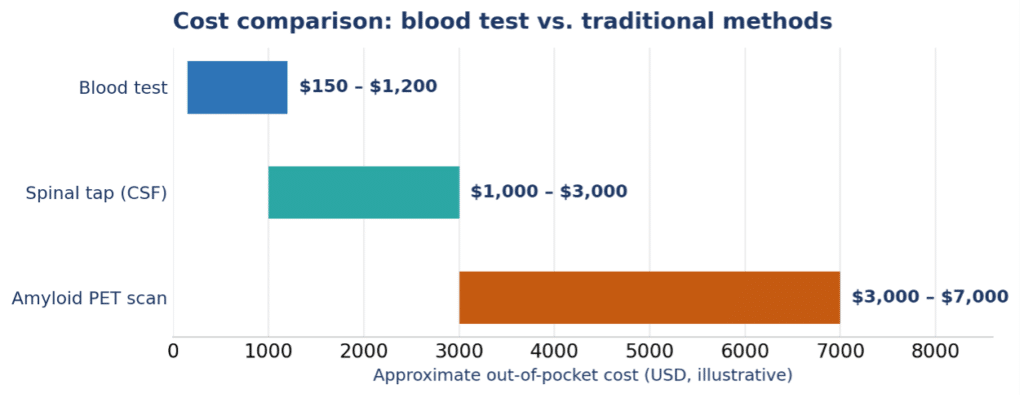
Figure 4. Illustrative cost ranges. Blood tests are substantially cheaper than PET imaging or spinal-fluid analysis; actual prices and insurance coverage vary.
What Does a Positive or Negative Result Mean?
Limitations and Important Cautions
- • Not a stand-alone diagnosis. Results must be interpreted alongside clinical evaluation; no blood test diagnoses Alzheimer’s by itself.
- • False positives and negatives happen. The FDA warns that a false positive could lead to an incorrect diagnosis, unnecessary treatment, anxiety, and cost—while a false negative could delay appropriate care.
- • Not for asymptomatic screening. Direct-to-consumer testing of people without symptoms remains controversial and is not recommended by expert bodies.
- • Other factors can affect results. Kidney function, certain medical conditions, and even body mass index can influence biomarker levels, which is why validated thresholds and clinical context matter.
The Future of Blood-Based Alzheimer’s Testing
Frequently Asked Questions
Can a blood test detect Alzheimer’s before symptoms appear?
Is the blood test as accurate as a PET scan?
How do I get a blood test for Alzheimer’s?
Will insurance cover it?
References
- 1. U.S. Food and Drug Administration. FDA Clears First Blood Test Used in Diagnosing Alzheimer’s Disease (May 2025). https://www.fda.gov/news-events/press-announcements/fda-clears-first-blood-test-used-diagnosing-alzheimers-disease
- 2. Mayo Clinic. New FDA-approved blood tests for diagnosing Alzheimer’s disease. https://www.mayoclinic.org/diseases-conditions/alzheimers-disease/in-depth/new-blood-tests-alzheimers/art-20585060
- 3. NeurologyLive. FDA Clears Lumipulse Plasma Ratio as First Blood Test for Diagnosing Alzheimer Disease. https://www.neurologylive.com/view/fda-clears-lumipulse-plasma-ratio-first-blood-test-diagnosing-alzheimer-disease
- 4. Alzheimer’s Association International Conference 2025. New Clinical Practice Guideline for Blood-Based Biomarkers. https://aaic.alz.org/releases-2025/clinical-practice-guideline-blood-based-biomarkers.asp
- 5. Palmqvist S, et al. Alzheimer’s Association Clinical Practice Guideline on blood-based biomarkers. Alzheimer’s & Dementia (2025). https://alz-journals.onlinelibrary.wiley.com/doi/10.1002/alz.70535
- 6. Plasma P-tau217, GFAP, and NfL as biomarkers for Alzheimer’s disease. PMC (2025). https://pmc.ncbi.nlm.nih.gov/articles/PMC12696028/
- 7. Ruling in, ruling out: the clinical utility of plasma biomarkers in diagnosis of Alzheimer’s disease. PMC (2025). https://pmc.ncbi.nlm.nih.gov/articles/PMC12483549/
- 8. Diagnostic accuracy of plasma p-tau217/Aβ42 for Alzheimer’s disease in clinical and community cohorts. PMC. https://www.ncbi.nlm.nih.gov/pmc/articles/PMC11953589/
- 9. Plasma phospho-tau217 for Alzheimer’s disease diagnosis using a fully automated platform. PMC. https://www.ncbi.nlm.nih.gov/pmc/articles/PMC12176611/
- 10. Labcorp Launches First FDA-Cleared Blood Test for Alzheimer’s Disease. https://ir.labcorp.com/news-releases/news-release-details/labcorp-launches-first-fda-cleared-blood-test-alzheimers-disease
- 11. Quest Diagnostics to Offer FDA-Cleared Fujirebio Blood Test for Alzheimer’s Disease. https://ir.questdiagnostics.com/press-releases/press-release-details/2025/Quest-Diagnostics-to-Offer-FDA-Cleared-Fujirebio-Blood-Test-for-Alzheimers-Disease/default.aspx
- 12. Being Patient. Your Guide to Alzheimer’s Blood Tests: Pricing, Accuracy, and Where to Get One. https://beingpatient.com/how-much-is-an-alzheimers-blood-test/
- 13. UCHealth. New blood tests for Alzheimer’s may allow for earlier detection. https://www.uchealth.org/today/new-blood-tests-for-alzheimers-may-allow-for-earlier-detection/
- 14. Medical News Today. FDA clears first blood test for Alzheimer’s: How does it work? https://www.medicalnewstoday.com/articles/first-blood-test-alzheimers-gets-fda-greenlight-3-things-to-know


Leave a Reply