


Your Guide to the Modern Life Sciences Network
For decades, progress in life sciences has been hampered by a simple, frustrating reality: brilliant minds and powerful data are often trapped in silos. A pharmaceutical company runs its own trials, a hospital gathers patient data for internal use, and an academic lab publishes groundbreaking findings that might take years to reach those who can act on them.
But what if we could tear down those walls? What if we could build a superhighway connecting all these crucial players?
What Is a Life Sciences Network and Why Does It Matter?
At its core, a life sciences network is a strategic, collaborative ecosystem. It’s not a single piece of software or a physical place, but a framework that links pharmaceutical giants, innovative biotechs like NeuroDex, top-tier research hospitals, and academic labs into a single, cooperative environment.
The entire point is to accelerate discovery. By creating a shared platform, a life sciences network allows data, expert insights, and new technologies to move at a speed that was once unthinkable.
The Shift from Silos to Synergy
This model represents a fundamental shift from isolated work to integrated synergy. Instead of each organization working alone, they form a cooperative web designed to solve problems faster.
This change is absolutely essential for tackling incredibly complex diseases like Parkinson's, Alzheimer's, and ALS, where real progress depends on piecing together massive, diverse datasets from thousands of sources. It's about combining our strengths to achieve what no single entity could accomplish on its own.
The modern life sciences supply chain faces a constant, unrelenting barrage of disruptions. To operate profitably, it must be built to flex under that pressure and not break. It’s not enough to arrive at a collaborative decision—all stakeholders must also execute that decision quickly, in an orchestrated manner.
This orchestrated approach ensures that a breakthrough in one lab can rapidly inform a clinical trial across the country, creating a powerful feedback loop for innovation.
Core Components of a Life Sciences Network
A functional network isn't just a loose agreement to collaborate; it's built on several key pillars that work together to create a powerful, unified system. Each component plays a specific role, contributing to the overall goal of accelerating medical breakthroughs.
The table below breaks down these fundamental building blocks.
| Component | Primary Function | Example Participants |
|---|---|---|
| Diverse Participants | To bring a wide range of expertise, resources, and perspectives to a common problem. | Pharma, biotechs, CROs, academic centers, hospitals, diagnostic labs. |
| Shared Infrastructure | The technological backbone that enables secure and efficient data and resource sharing. | Cloud platforms, secure data-sharing protocols, communication tools. |
| Clear Governance | Establishes trust and transparency by defining the rules of engagement for all members. | Data ownership agreements, IP rights, decision-making frameworks. |
| Standardized Data | Ensures that data from different sources can be combined and analyzed effectively. | Common data formats, collection protocols, analytical standards (e.g., for biomarker data). |
These components create a cohesive structure where innovation can flourish, securely and efficiently.
This model is fueling massive investment in the digital tools needed to make it all work. In fact, the global life sciences IT market is projected to skyrocket from USD 26.33 billion in 2026 to USD 67.69 billion by 2034, growing at an impressive 11.06% CAGR. This boom is driven by the need for advanced IT solutions to manage the complex, high-volume datasets generated by technologies like those that isolate neuron-derived extracellular vesicles (NDEs) for biomarker analysis.
This collaborative model is more than a trend; it's a fundamental change in how modern medicine advances. By connecting the right partners with the right tools, a life sciences network creates an environment where discovery can truly thrive. If you're looking to form these crucial connections, you might want to learn more about how to find a biotech lab near you.
The Five Essential Types of Life Sciences Networks
While everyone in our field shares the goal of accelerating discovery, not all collaborations are built the same. A life sciences network can take many forms, with its structure carefully shaped by its specific mission. Think of it like a specialized toolkit—you wouldn't use a hammer to turn a screw. In the same way, our industry uses distinct network models to tackle different challenges.
Getting a handle on these models is the key to figuring out where your organization can make the biggest impact. Each one opens up a unique path for collaboration, spanning everything from foundational science to the final hurdles of clinical validation.
Let's break down the five essential types that form the real backbone of biomedical innovation.
1. Research Consortia
Picture a research consortium as a scientific supergroup. This is where top minds from academia and industry join forces to attack fundamental scientific questions too big for any single organization to handle alone. They pool intellectual firepower, pre-clinical models, and foundational data to really dig into the basic biology of a disease.
For a company like NeuroDex, joining a consortium focused on synucleinopathies means gaining access to a treasure trove of academic knowledge and patient samples. In return, we can offer our specialized biomarker services, helping the group get a clearer picture of the molecular drivers behind diseases like Parkinson's. This kind of life sciences network is all about generating new knowledge from the ground up.
2. Clinical Trial Networks
If a consortium is the supergroup, a clinical trial network is the mission control for drug development. These networks link multiple hospitals and clinical sites under a single, unified protocol. The result? Streamlined patient recruitment and perfectly standardized data collection across huge, multi-center studies. Their entire purpose is built around operational efficiency and speed.
A sponsor can tap into one of these networks to rapidly find sites with specific patient populations, like people newly diagnosed with ALS. By integrating a technology like NeuroDex's TDP-43 biomarker assay into the network's master protocol, that sponsor ensures every single site uses the exact same validated test for patient stratification. This move dramatically boosts data quality and consistency across a global trial.
A clinical trial network’s power is in its ability to orchestrate the complex logistics across dozens of independent sites, turning what could be a logistical nightmare into a synchronized operation. That kind of coordination is non-negotiable for running the large-scale neurology trials required for regulatory approval.
This structure is designed to do one thing: shorten the path from a promising compound to an approved therapy by taming the most challenging phase of drug development.
3. Diagnostic and Lab Partnerships
This type of life sciences network is all about getting new diagnostic tools out of the lab and into the clinic. It builds a critical bridge between a technology developer—like us—and the clinical laboratories that will actually run the test for patients. These partnerships are essential for generating the real-world evidence needed for regulatory clearance and widespread clinical adoption.
For instance, NeuroDex might partner with a network of CLIA-certified labs to validate our Alzheimer's-focused tau/pTau biomarker panel. These labs would run our assay on thousands of real-world patient samples, producing the robust performance data that regulators and clinicians need to see. This is the collaboration that turns a powerful research tool into a trusted clinical diagnostic.
4. Data-Sharing Federations
Imagine being able to pool health data from millions of patients without ever moving the data or compromising a single person's privacy. That’s the magic of a data-sharing federation. These networks use sophisticated, privacy-preserving technologies that let researchers run analyses on combined datasets that never leave their home institutions.
A researcher could query a federated network like this to explore the link between a specific genetic marker and disease progression across incredibly diverse patient populations. This approach provides immense statistical power while rigorously adhering to data governance rules and patient confidentiality.
5. Innovation and Commercialization Hubs
Finally, you have innovation hubs, which act as ecosystem accelerators. They are the connectors, linking promising startups with the funding, mentorship, and strategic partners they need to grow. These networks are less about a single scientific project and more about cultivating the next generation of life science companies. Beyond these five core types, further inspiration for network structures can be drawn from various Community of Practice examples.
By participating in a hub, a young biotech can gain crucial visibility, find its first customers, and secure the capital needed to scale its operations—transforming a brilliant idea into a commercial success.
Building and Governing a High-Functioning Network
Putting together a powerful life sciences network is about more than just plugging in computers and opening up data streams. It’s about building a solid foundation of trust, clear rules, and shared purpose. Without that human framework, even the most sophisticated technology is bound to fall short.
Think of it like drafting the constitution for a new country. You have to define how members will work together, protect their own interests, and drive the whole group toward success. This all starts with a robust governance model.
Governance is the engine room of the network. It dictates everything from how decisions get made to how intellectual property is managed, creating the trust needed for organizations to share their most valuable data and insights without hesitation. It's not a formality—it’s the core agreement that keeps the collaboration productive and fair.
The Pillars of Effective Governance
For any collaboration to work, the governance framework has to spell out a few key things right from the start:
- Decision-Making Rights: Who has the final say on research priorities, new members, or how shared resources are spent?
- Data Contribution and Access Rules: What data is everyone expected to contribute? Just as important, who gets to access it, and under what specific conditions?
- Intellectual Property (IP) Management: How will discoveries made together be owned and commercialized? This is often the trickiest and most sensitive part of the negotiation.
- Publication Policies: Clear guidelines on publishing research findings ensure everyone gets fair credit and protects the interests of all contributors.
Without these rules of the road, even the most promising network can get bogged down in disputes and mistrust.
Data Standards: The Universal Language of Collaboration
Once the rules are set, the next hurdle is technical: getting everyone to speak the same language. This is where data standards become essential. Data from different labs, hospitals, or countries is often a mess of mismatched formats and terminologies, making it nearly impossible to combine and analyze.
Adopting a common standard is like agreeing that everyone will use the metric system instead of a jumble of inches, feet, and cubits. The FAIR Guiding Principles are the gold standard here, ensuring data is Findable, Accessible, Interoperable, and Reusable.
For a life sciences network to function, data must be more than just available; it must be intelligible and usable to all members. This shared understanding is what transforms a collection of isolated datasets into a powerful, integrated source of knowledge.
This is non-negotiable when dealing with complex biomarker data, where consistency is the only way to generate reliable insights for the clinic.
Security and Regulatory Compliance
Finally, the entire network has to be built on a bedrock of uncompromising security and regulatory adherence. With patient privacy and priceless IP on the line, there is zero room for error. Ensuring data integrity is paramount, and a C-Level Guide to healthcare data engineering and HIPAA compliance offers a great overview of these critical considerations.
If a network aims to support clinical trials, all data generation and handling must meet strict GLP (Good Laboratory Practice) and CLIA (Clinical Laboratory Improvement Amendments) standards. These regulations ensure data is reliable, reproducible, and ready for regulatory submissions. This is where specialized partners come in. Organizations like NeuroDex can ensure these standards are met across the board; you can learn more by exploring options for partnering with a biotech vendor.
This intense focus on governance and standards isn't just a technical exercise—it’s driving serious economic activity. Dealmaking within these networks is booming, with 36 major transactions worth $115 billion recorded by Q3 2025. As seen in insights about life sciences growth on EY.com, this activity is helping large pharma companies plug a looming $300 billion growth gap from patent cliffs, opening up massive opportunities for innovators with validated biomarkers.
Let's move past the theory. The true power of a life sciences network isn't in abstract diagrams or mission statements—it's in how it completely changes the game for a real-world clinical trial.
To see what this looks like, we'll follow a hypothetical Phase II trial for a new Parkinson's disease therapeutic. This is where concepts like governance and data standards stop being buzzwords and start generating real clinical progress.
Imagine a mid-sized sponsor, let's call them "NeuroNova," with a promising drug that targets alpha-synuclein aggregation. The traditional route is a slow, painful grind. They’d spend months, even a year, finding and contracting individual trial sites, bogged down by administrative headaches and endless delays.
But NeuroNova isn’t going the traditional route. They're part of a clinical trial network.
From Months to Weeks Finding the Right Patients
Instead of playing phone tag with hospitals, NeuroNova accesses the network’s shared database. This is far more than a simple contact list. It’s a living, breathing resource with de-identified data from hundreds of member sites around the world.
In a matter of days, their clinical ops team can pinpoint the exact sites with the patients they need: individuals diagnosed in the last three years, not taking conflicting drugs, and carrying specific genetic markers linked to faster disease progression.
Because the network operates on pre-established master agreements, the site activation process—which used to take six months per site—is slashed to just a few weeks. Before the first patient is even enrolled, NeuroNova has already shaved nearly a year off its timeline.
A life sciences network turns site selection from a slow, speculative gamble into a fast, data-driven strategy. It empowers sponsors to find not just any patients, but the right patients, dramatically improving the odds of a successful trial.
This head start in finding and activating the right sites creates a ripple effect, making the entire trial more precise and efficient from day one.
Integrating Precision Biomarkers for Clearer Signals
Now for the next big step. To sidestep the vague, subjective endpoints that have sunk so many past Parkinson's trials, NeuroNova decides to build its study around a solid biomarker strategy. They partner with NeuroDex to roll out our validated, blood-based α‑synuclein assay across every site in the network.
Since NeuroDex’s services are designed for exactly this kind of network integration and run to GLP/CLIA standards, deployment is seamless. Every site gets the same collection kits and follows a single, unified protocol. A blood sample drawn in Boston is handled and processed exactly like one from Berlin, eliminating site-to-site variability.
This move delivers two huge wins right away:
- Drastically Fewer Screen Failures: The biomarker test is used during screening to confirm that only patients with the specific alpha-synuclein pathology are enrolled. This one step filters out individuals who would never respond to the drug anyway, leading to a massive reduction in screen failures and saving millions in trial costs.
- Early Pharmacodynamic (PD) Readouts: As patients begin treatment, blood samples are taken at set intervals. The network's built-in logistics get those samples to NeuroDex for rapid analysis.
Building the foundation for this kind of seamless collaboration requires a clear, step-by-step process focused on trust and interoperability.
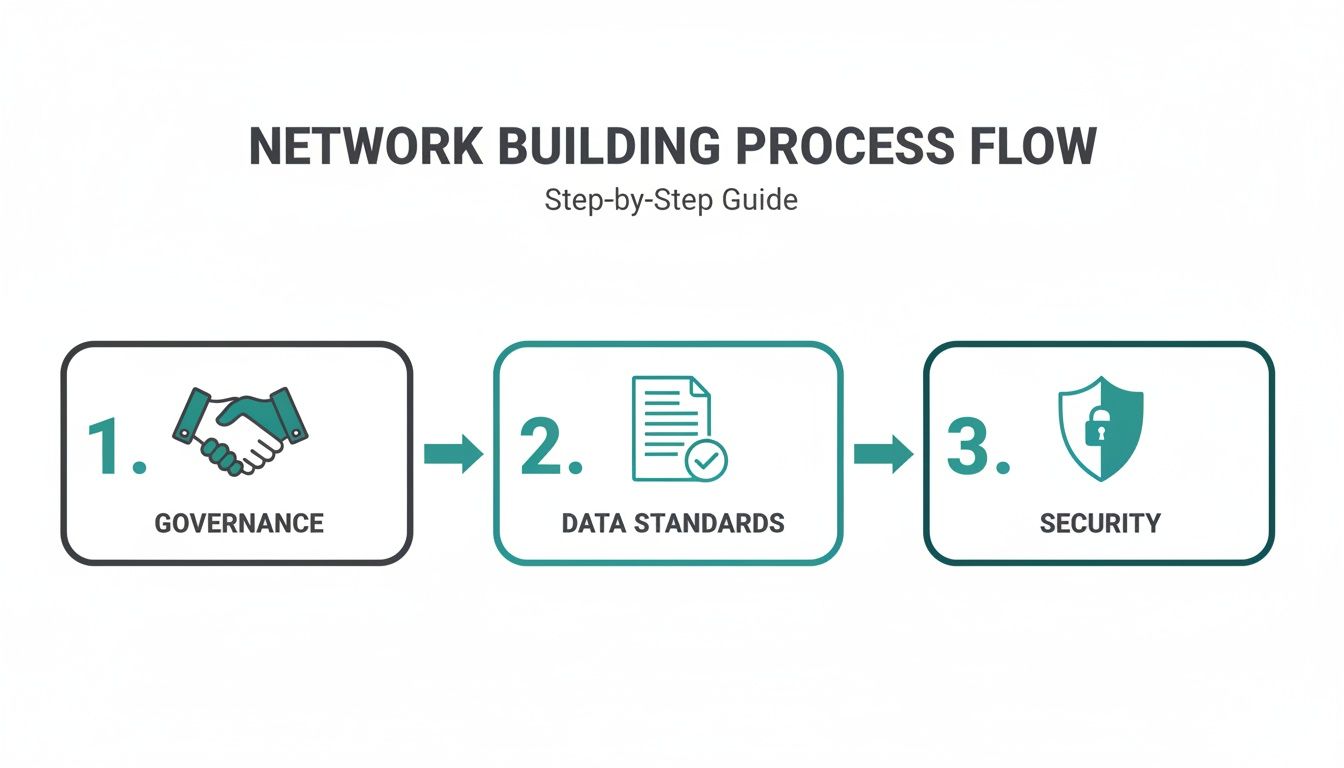
It all starts with solid governance, which then enables common data standards and security protocols—the three pillars that make a functional network possible.
Within a few months, NeuroNova gets the signal they've been waiting for. Objective data flowing back through the network shows a clear, dose-dependent drop in pathological alpha-synuclein in the treated group. This isn't a subjective clinical rating; it's hard biological proof that the drug is hitting its target. This is the kind of powerful, early data that fuels confident go/no-go decisions and secures the next round of investment. Anyone planning a similar study should explore NeuroDex's full suite of clinical trial services to understand what's possible.
In this scenario, the life sciences network isn't just a background utility; it's the central nervous system of the entire trial. It's the conduit for finding patients, the platform for deploying advanced biomarkers, and the pipeline for collecting clean, actionable data in near real-time. For a sponsor like NeuroNova, this collaborative model transforms a high-risk, slow-moving study into a faster, smarter, and far more insightful endeavor, clearing the path toward regulatory approval.
To better visualize this shift, here’s a look at how a network-enabled approach with NeuroDex compares to the old way of doing things.
Traditional vs. Network-Enabled Neurology Trial
This table breaks down the efficiency gains and improved data quality when biomarker services like ours are integrated into a clinical trial network.
| Trial Stage | Traditional Approach | Network-Enabled Approach with NeuroDex Integration |
|---|---|---|
| Site Selection & Activation | 6-12 months; manual outreach; site-by-site contract negotiation. | 1-3 months; data-driven site identification; pre-negotiated master agreements. |
| Patient Screening | High screen failure rates (up to 50%) due to reliance on clinical symptoms alone. | Significantly lower screen failure rates; NeuroDex assay confirms molecular pathology upfront. |
| Data Collection | Inconsistent sample handling across sites; data arrives in batches with long delays. | Standardized collection protocols; centralized logistics for rapid sample shipment to NeuroDex. |
| Pharmacodynamic Readouts | Relies on late-stage clinical outcomes (12-18 months); no early biological signal. | Early, objective PD readouts (3-6 months) show target engagement via α‑synuclein levels. |
| Decision Making | High-risk go/no-go decisions based on limited, subjective data. | Data-rich, evidence-based decisions supported by clear biological proof-of-concept. |
| Overall Trial Efficiency | Slow, costly, and high-risk due to administrative friction and data ambiguity. | Faster, more cost-effective, and de-risked with clearer biological signals and operational speed. |
As you can see, the network doesn't just make things incrementally better—it fundamentally changes the risk-reward equation for neurology drug development.
How Precision Biomarkers Power the Network
A life sciences network is built on a foundation of trust and shared goals, but it runs on one thing: high-quality data. If the network’s governance provides the rules of the road, and its infrastructure is the highway system, then precision biomarkers are the high-octane fuel that actually moves everything forward.
Without reliable, standardized biological data, even the most ambitious collaboration is just an empty shell. The entire point is to move beyond subjective clinical observations and anchor research in objective, measurable biology. This requires tools that can consistently and accurately quantify the molecular changes happening inside a patient.
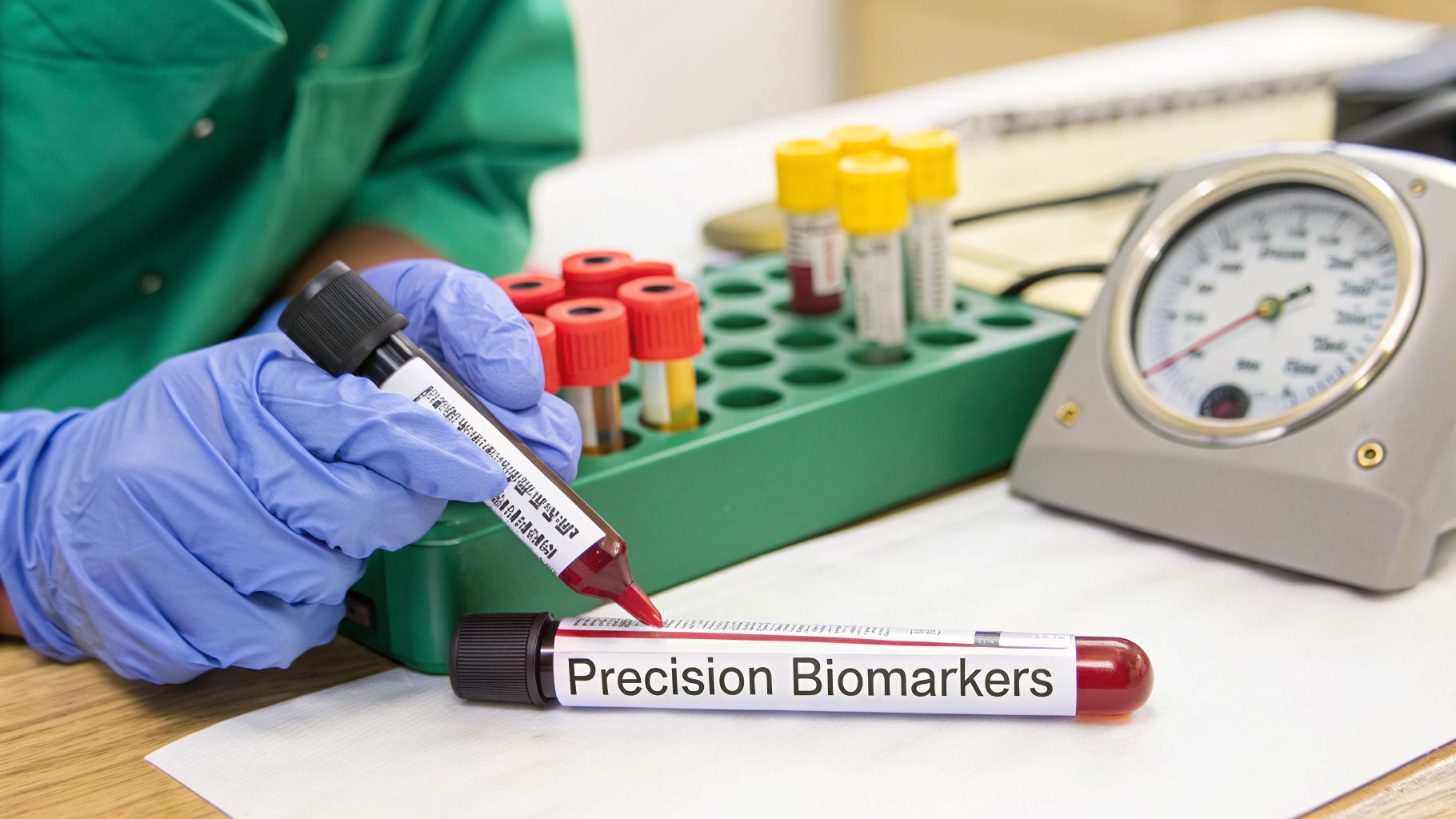
From a Simple Blood Draw to Brain-Specific Data
For decades, studying the brain meant relying on invasive spinal taps to get cerebrospinal fluid or waiting for post-mortem tissue. NeuroDex’s ExoSort technology completely changes this paradigm by isolating brain-derived signals from a simple blood sample. It specifically targets and captures neuron-derived extracellular vesicles (NDEs)—tiny packages released by brain cells that successfully cross the blood-brain barrier.
These NDEs carry a cargo of proteins, lipids, and nucleic acids that act as a direct biological snapshot of what’s happening in the brain. This "liquid biopsy" for the brain finally gives researchers and clinicians a non-invasive window into neurological disease biology.
This kind of technology is a major driver of the incredible growth within the life science tools market. This massive ecosystem, which forms the technical backbone for genomic, proteomic, and cellular analysis, was valued at USD 176.93 billion in 2025. Projections show it expanding to USD 402.18 billion by 2032, reflecting a powerful CAGR of 10.81%. As detailed in a recent market report on life science tools from Skyquest Technology Consulting, this surge comes from the demand for high-throughput platforms just like ExoSort, which enable precision neurology by analyzing key proteins.
The Plug-and-Play Data Source for Networks
For a life sciences network to work, its data sources have to be easy to integrate. They need to be "plug-and-play" components that slot seamlessly into a larger workflow. NeuroDex’s biomarker services are designed to be exactly that—a critical source of high-quality biological data, built for seamless network deployment.
By providing a panel of validated biomarkers under strict GLP/CLIA-compliant standards, we deliver the reliable and standardized data needed to make collaborative research truly powerful.
A network is fueled by data that is not just accurate but also universally understood. Standardized biomarker assays ensure every participant—from an academic lab in Japan to a CRO in Germany—is measuring the exact same biological signal in the exact same way.
This consistency is what eliminates the data variability that can so often derail multi-site collaborations, turning what would have been noisy results into clear, actionable insights.
Empowering Every Network Participant
This high-quality data provides tangible benefits that strengthen every link in the chain. The availability of validated, blood-based biomarkers empowers different participants in very specific ways:
- Academic Researchers: Gain access to sensitive tools for exploring new disease pathways and validating novel targets in human samples. This radically accelerates the journey from basic discovery to translational science.
- Biotech and Pharma Sponsors: De-risk clinical trials with objective patient stratification, get early pharmacodynamic (PD) readouts, and generate clear proof-of-concept data. The result is more confident go/no-go decisions.
- Clinical Research Organizations (CROs): Offer enhanced, higher-value services to clients by integrating cutting-edge biomarker analysis into their workflows, improving trial efficiency and delivering stronger data packages for regulatory submissions.
Our panel of validated biomarkers for neurology—including α‑synuclein, tau/pTau, and NF-L—provides the specific, actionable information needed to drive real progress. This is how precision biomarkers turn the promise of a life sciences network into a practical, powerful reality.
Of course. Here is the rewritten section, adopting the expert, natural voice and style from your examples.
Your Questions Answered: The Practical Side of Life Sciences Networks
Stepping into a collaborative ecosystem like a life sciences network is a big move. We get it. R&D leaders, clinical operations managers, and biotech innovators are right to ask tough questions about the practicalities. The promise of faster discovery is exciting, but real-world concerns about cost, data security, and tangible value are completely valid.
Here, we’ll give you direct answers to the most common questions we hear. Our goal is to cut through the noise and show how joining or even building a network can be a smart, strategic move for any organization serious about advancing neuroscience.
How Much Does It Cost To Join or Build a Network?
Let's address the elephant in the room: the cost. There's no single price tag. Your financial commitment to a life sciences network could be a manageable annual membership fee for an established consortium, or it could be a significant capital investment if you’re building a private, proprietary network from the ground up.
But focusing only on the upfront cost misses the entire point. The real conversation isn’t about cost; it’s about the return on that investment (ROI). Joining a network isn’t a cost center—it’s a strategic play to secure a competitive edge.
Think about the staggering expense of a failed or delayed clinical trial. A single Phase III trial in neurology can easily run into the hundreds of millions of dollars.
By accelerating timelines, cutting down screen failure rates, and enabling faster, data-driven decisions, a network delivers returns that completely dwarf the initial expense. The ability to shave a year off development or sidestep a costly trial failure represents an ROI that is orders of magnitude greater than any membership fee.
This strategic investment shifts your resources from just fixing problems to actively preventing them, creating a much more efficient and predictable path to market.
Is Our Proprietary Data Safe in a Shared Network?
This is often the number one concern, and for good reason. Your intellectual property and patient data are your most valuable assets. Protecting them is absolutely non-negotiable.
Modern life sciences networks are built on robust security frameworks designed specifically for these high-stakes environments. They aren't open free-for-alls where data is passed around casually.
One of the most powerful approaches used is federated learning. In this model, algorithms are sent to the data, not the other way around. This means your raw, proprietary data—whether it's patient-level information or sensitive preclinical research—never leaves your own secure servers. The model learns from your data locally and only sends back anonymized, aggregated insights to the central hub.
These technical safeguards are then reinforced by ironclad legal agreements:
- Data Use Agreements (DUAs): These legally binding contracts spell out exactly who can access what data, for what specific purpose, and for how long.
- Advanced Encryption: All data, whether in transit or at rest, is protected with state-of-the-art encryption, making it unreadable to any unauthorized party.
- Rigorous Anonymization: Before any insights are shared, all personally identifiable information is stripped away using advanced techniques, ensuring patient privacy is always maintained.
These layers of security and governance are what build the foundation of trust needed for true, meaningful collaboration.
Can Small Biotech Companies Really Benefit?
Absolutely. In fact, small biotechs often have the most to gain. A life sciences network acts as a powerful equalizer, giving smaller innovators access to the kinds of resources, data, and partnership opportunities that were once the exclusive domain of large pharmaceutical companies.
Imagine you're a small biotech with a groundbreaking biomarker assay but limited visibility. In the traditional model, you'd spend years trying to get in front of the right people, one meeting at a time. It's a slow, uphill battle.
Within a network, that dynamic gets flipped on its head.
By plugging your technology into the network, you can demonstrate its value to a dozen potential partners at once. A life sciences network gives your specialized expertise a platform, amplifying your voice and connecting you directly with the organizations that need your solution the most.
For a company like NeuroDex, this means our ability to provide precise, blood-based neurological biomarkers isn't just a slide in a pitch deck; it becomes a tangible, integrated solution that network members can see and use in real time. It’s the fastest way to prove value and build powerful commercial relationships.
What Is the First Step To Integrate Our Trials?
Getting started is more straightforward than you might think. You don't have to build an entire network from scratch. The most practical first step is to identify and engage with existing networks and consortia that are already active in your therapeutic area.
Here’s a simple roadmap to get you started:
- Identify Relevant Networks: Research academic consortia, clinical trial networks, or patient advocacy foundations focused on your disease of interest (e.g., Parkinson's, ALS, Alzheimer's).
- Initiate Contact: Reach out to the network's leadership. Don't lead with a hard sell. Instead, express genuine interest in their mission and ask how your organization might contribute.
- Propose a Pilot Project: Suggest a small-scale, well-defined pilot. This allows both sides to test the waters with minimal risk. For example, you could offer to run your biomarker assay on a small cohort of stored samples from one of their previous studies.
Most importantly, the key to a smooth integration is being prepared. Your "ticket" into the network is having high-quality, standardized data ready to go. Demonstrating that your assays are run under GLP/CLIA standards and that your data is clean, consistent, and ready for analysis shows potential partners that you are a serious, capable collaborator. This preparation makes you an attractive partner and dramatically simplifies the technical integration process.
At NeuroDex Inc, we design our biomarker services with network integration in mind, providing the validated, GLP/CLIA-compliant data that powers successful collaborations. Our ExoSort technology delivers brain-specific insights from a simple blood draw, enabling you to bring clear, actionable data to any partnership. Learn how we can help you accelerate your neurology programs by visiting https://neurodex.co.
Leave a Reply