



Biotechnology Technician Job Description for Neurology Labs
A biotechnology technician job description, especially for a role in a specialized neurology lab, details a position for a hands-on expert who turns complex scientific research into hard, actionable data. These technicians are the engine room of discovery, meticulously processing biological samples and running advanced equipment to uncover critical insights into neurological diseases.
What Does a Biotechnology Technician in Neurology Do?
Think of a highly skilled crew on a deep-sea exploration vessel. The vast, complex ocean is the human bloodstream, and their mission is to find and retrieve tiny, treasure-filled capsules launched from the brain. This is the world of a biotechnology technician in a neurology biomarker lab. They are the ones who bridge the gap between abstract scientific theory and the tangible discoveries that can ultimately change patients' lives.
Their main focus is on the precise isolation and analysis of specific biological messengers. Known as neuron-derived extracellular vesicles (NDEs) or exosomes, these particles are released by brain cells and travel through the bloodstream. They function like messages in a bottle, carrying vital molecular information about the health of the central nervous system.
The Hunt for Neurological Biomarkers
Technicians use advanced platforms, such as NeuroDex's ExoSort technology, to capture these brain-specific exosomes from a simple blood sample. The process is a bit like having a special magnet that only attracts the capsules sent from neurons, ignoring everything else floating in the bloodstream.
Once isolated, the real work begins. The technician’s job is to search for specific biomarkers—molecules that signal the presence or progression of a disease. In the world of neurology, some of the most critical biomarkers include:
- α‑synuclein: A protein closely associated with Parkinson's disease.
- TDP-43: A key molecular indicator for ALS and frontotemporal dementia (FTD).
- Tau and pTau: Well-known hallmarks of Alzheimer's disease.
By carefully measuring the levels of these proteins, technicians generate the crucial data that helps researchers and clinicians understand disease mechanisms, stratify patients for clinical trials, and monitor how well a new therapy is working.
A biotechnology technician is the backbone of modern neurotherapeutics development. Their precision in the lab directly impacts the quality of data used to make multi-million dollar decisions in pharmaceutical R&D and supports the journey toward personalized medicine for neurological disorders.
A Stable and Growing Career Path
This vital role isn’t just scientifically rewarding; it offers a stable career with significant growth potential. The job outlook for biotechnology technicians is quite solid. The U.S. Bureau of Labor Statistics projects a 3% employment growth from 2024 to 2034, which translates to about 9,100 job openings each year. For a closer look, you can explore the BLS findings on biological technicians.
This stability is absolutely critical for the biopharma teams and diagnostic labs that depend on these skilled professionals to push neurological science forward.
To give you a clearer picture, here’s a quick overview of what this specialized biotechnology technician job description truly entails.
Biotechnology Technician at a Glance: Neurology Biomarker Lab
| Aspect | Description |
|---|---|
| Core Function | Execute laboratory procedures to isolate and analyze biomarkers from biological samples, primarily neuron-derived exosomes from blood. |
| Key Techniques | Exosome isolation (e.g., ExoSort), ELISA, qPCR, Nanoparticle Tracking Analysis (NTA), Flow Cytometry. |
| Primary Goal | Generate accurate, reproducible data on neurological biomarkers (e.g., tau, TDP-43) to support clinical trials and research. |
| Work Environment | Regulated laboratories (GLP/CLIA), academic research centers, and pharmaceutical R&D facilities. |
| Required Skills | Meticulous attention to detail, strong organizational skills, proficiency with lab equipment, and data documentation. |
This table captures the essence of the role—a position that demands technical skill, precision, and a deep understanding of the scientific context behind the work. It's a job for those who want to be at the very center of where discovery happens.
Core Responsibilities in a Neurology Lab
A biotechnology technician's work in a neurology lab is a story of precision and purpose. It's about turning a biological sample into data that can illuminate the complex processes of the brain. The day doesn't just start with samples; it begins with the meticulous preparation and calibration of the highly sensitive instruments that are the backbone of any serious research operation.
This foundational work is everything. You wouldn't try to capture a detailed image of a distant galaxy without first cleaning the lenses and perfectly aligning your telescope. In the same way, a technician ensures every pipette, centrifuge, and specialized analytical platform like ExoSort operates at peak performance before a single patient sample is even thawed.
From Sample to Signal
With the lab environment fully primed, the real work begins: processing patient samples, usually blood plasma or serum. The primary objective is to hunt down and isolate precious neuronal exosomes—tiny vesicles that act as molecular messengers, carrying signals straight from the brain. This is where a technician’s skill truly comes into play.
The process is unforgiving. A tiny error—a slight temperature deviation or a miscalculation in reagent volume—can compromise the entire sample, rendering it useless. When you're writing a biotechnology technician job description, you have to stress this demand for flawless execution. It's what separates clean, reliable data from a costly failed experiment.
This diagram shows the general workflow, from the moment a sample arrives to the final data output.
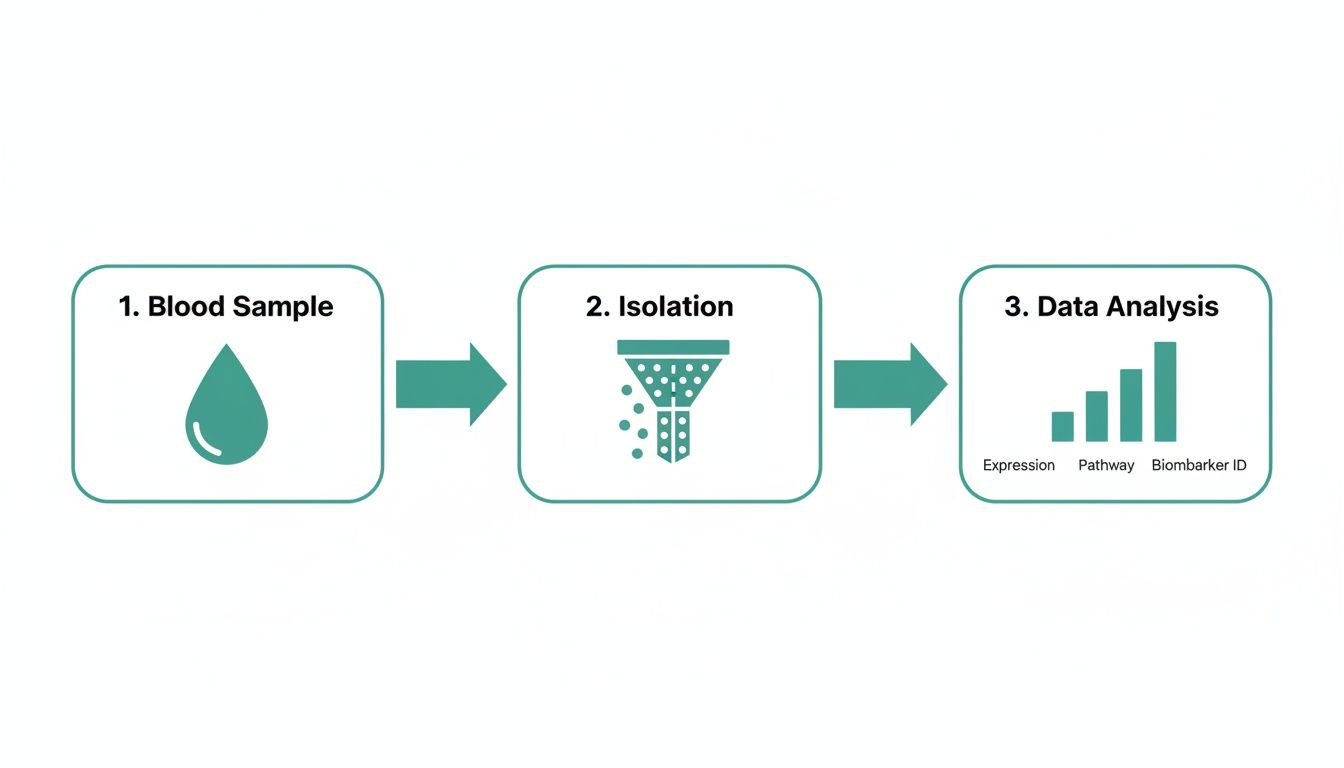
Every single step in this flow, from isolating the exosomes to analyzing their cargo, demands a specific technical skillset and obsessive attention to detail. The final chart isn't just a graph; it's a potential window into a patient’s neurological health.
Executing Complex Assays with Precision
Once the neuron-derived exosomes are successfully isolated, the technician shifts to the analytical phase. This involves running a battery of complex assays designed to measure the specific biomarkers under investigation. These aren’t simple, single-step tests but multi-stage procedures that demand both technical dexterity and a solid grasp of the underlying biology.
Common assays in this workflow include:
- ELISA (Enzyme-Linked Immunosorbent Assay): This is the workhorse for measuring the concentration of specific proteins like tau or α-synuclein. The technician prepares plates, adds samples and reagents in a precise sequence, and operates a plate reader to obtain the final quantitative results.
- qPCR (Quantitative Polymerase Chain Reaction): This technique is used to analyze nucleic acids, such as microRNAs, packed inside the exosomes. It helps researchers understand the changes in gene expression associated with a disease.
- Flow Cytometry: A powerful method for profiling individual exosomes, using surface proteins to confirm they actually came from neurons.
A skilled technician moves between these different techniques with confidence and accuracy. Their hands are essentially an extension of the principal investigator’s research strategy. To see how these methods contribute to a larger discovery effort, you can explore our guide on neurological biomarkers research services.
In a regulated setting like a CLIA or GLP laboratory, documentation isn't just paperwork—it is the data. Every action, measurement, and observation must be recorded with absolute clarity. This audit trail is what makes the data defensible, reproducible, and ultimately, fit to support clinical trial decisions.
Think about a Phase III clinical trial for a new Alzheimer's drug. That trial’s success might hinge on correctly identifying patients based on their biomarker profiles. A technician’s flawless execution of an ELISA for pTau directly impacts which patients are enrolled. An error at this stage could not only waste millions of dollars but, more critically, could obscure the real effectiveness of a therapy that might change lives. This high-stakes reality is why data integrity is their most important responsibility.
Essential Skills and Laboratory Techniques
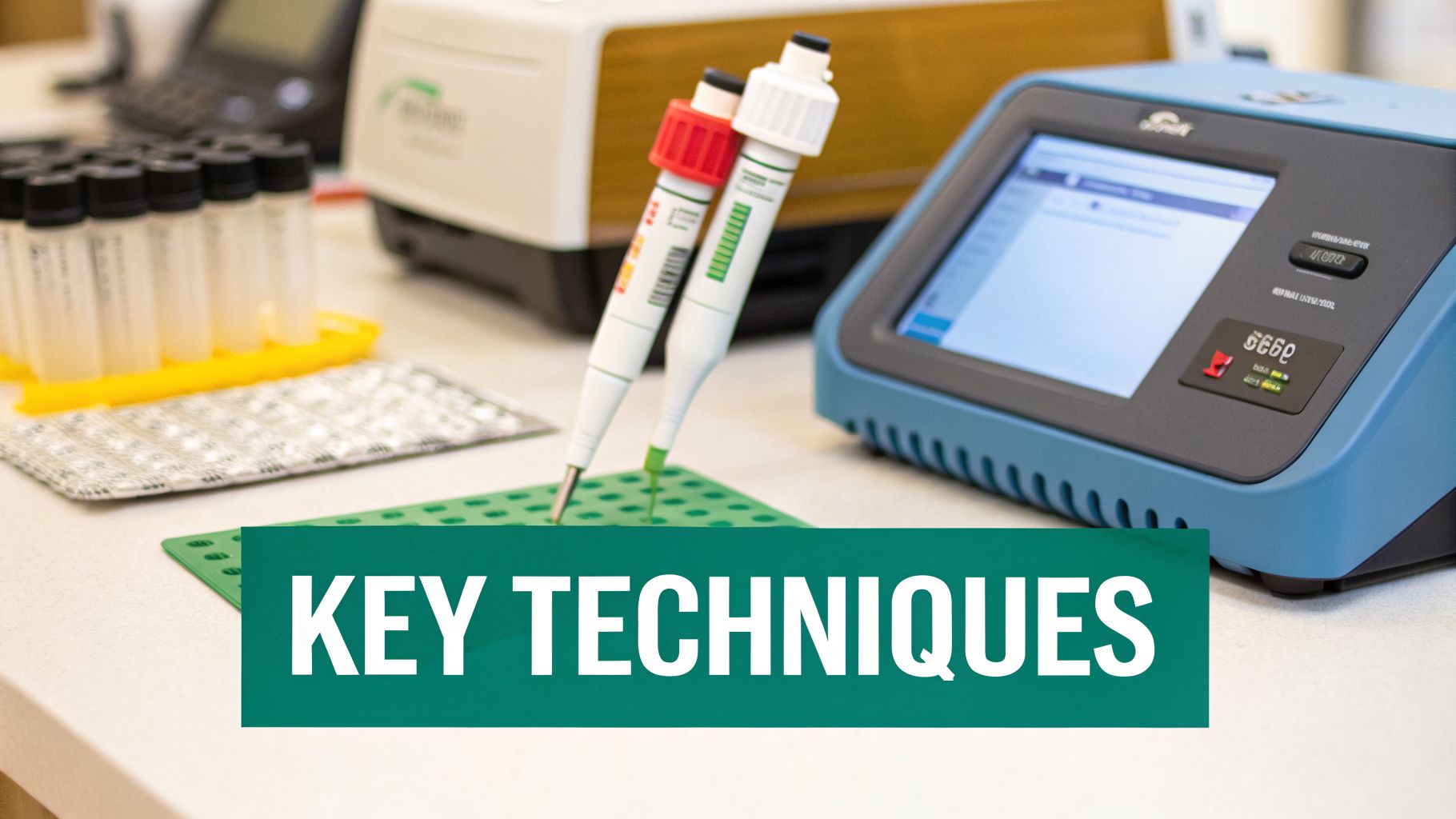
To excel in a high-stakes neurology lab, a biotech technician needs a skillset that goes far beyond general lab protocols. They require a specific toolkit of hands-on competencies directly tied to the unique demands of neurological biomarker research.
These skills are what turn a raw blood sample into game-changing clinical data. This isn't just about running tests; it’s about flawlessly executing a series of specialized procedures where every single step depends on the one before it. The final product isn't a report—it's pure, reliable, and actionable data.
Core Technical Competencies
Any serious biotechnology technician job description for a neurology-focused lab will center on a specific set of non-negotiable skills. These are the absolute fundamentals.
- Exosome Isolation: This is where everything starts. Using platforms like ExoSort, the technician must skillfully pull tiny neuron-derived vesicles out of complex fluids like blood plasma. It’s like panning for gold, but on a microscopic scale, demanding incredible precision to capture only the target particles.
- Sample Preparation: Before any analysis, samples have to be prepared with meticulous care. This involves exact dilutions, adding reagents without error, and handling everything in a way that prevents the fragile biomarkers inside the exosomes from degrading.
- Instrument Calibration and Maintenance: A technician is the guardian of the lab's equipment. They are responsible for making sure every instrument, from the simplest pipette to the most complex analyzer, is perfectly calibrated and maintained. This is proactive quality control.
Mastering these foundational skills ensures the material being analyzed is of the highest possible quality. An error at this stage will only get amplified in later steps, making this initial work arguably the most critical part of the entire process.
Advanced Analytical Techniques Explained
Once the exosomes are isolated and prepped, the technician uses a range of advanced methods to "read" the molecular story they contain. Each technique answers a different biological question, and a top-tier technician is fluent in all of them.
ELISA (Enzyme-Linked Immunosorbent Assay)
This is the lab’s workhorse for quantifying specific proteins. Think of it like having a lock (an antibody) that only a single, specific key (the target protein, like pTau) can fit. ELISA leverages this principle to measure exactly how much of that protein is in a sample.
A technician running an ELISA will pipette samples and reagents into a multi-well plate, incubate it, and then use a plate reader to measure the color change that reveals the protein’s concentration. The data from these assays gives researchers a direct line of sight into disease progression or a drug's effect. For a closer look, our guide on ELISA kit production details how these critical tools are made.
qPCR (Quantitative Polymerase Chain Reaction)
While ELISA measures proteins, qPCR is all about quantifying nucleic acids, such as microRNA. This technique involves amplifying minuscule amounts of genetic material until they reach detectable levels, allowing the technician to measure gene expression linked to neurological diseases.
Nanoparticle Tracking Analysis (NTA)
NTA is an essential quality control checkpoint. The technology visualizes and counts individual nanoparticles in real-time, which allows the technician to confirm the exact size and concentration of the isolated exosomes. This step ensures the sample is pure and fit for analysis, preventing the classic "garbage in, garbage out" problem.
Flow Cytometry
This sophisticated technique analyzes the physical and chemical characteristics of thousands of individual particles as they flow one-by-one past a laser. In a neurology context, it’s used to confirm that the isolated exosomes carry the correct surface markers, proving they actually came from neurons.
A technician's proficiency with these diverse techniques is what transforms them from a lab helper into a true research partner. Their ability to generate reliable data with ELISA, validate it with NTA, and characterize it with flow cytometry is what drives a project forward.
Finally, all of this demanding work must happen within a strict regulatory framework. Following CLIA (Clinical Laboratory Improvement Amendments) and GLP (Good Laboratory Practice) procedures isn't optional—it's an integral part of the job. This ensures every piece of data is traceable, defensible, and robust enough to support clinical trial submissions.
The Ideal Candidate: What to Look for Beyond the CV

Mastering complex lab techniques is just the price of entry. In the high-stakes environment of a neurology biomarker lab, the best technicians bring a specific mindset to the bench—a set of personal traits that are just as critical as technical skill. These are the qualities that separate a competent technician from an indispensable one.
Think of it this way: a technician needs the steady hands and methodical approach of a watchmaker. But they also need the critical thinking of a detective for when things inevitably go wrong. It's this powerful combination that defines a truly exceptional candidate.
Essential Personal Attributes
When you're writing a job description, these are the non-negotiable qualities that attract candidates who will not just survive, but thrive.
- Meticulous Attention to Detail: In biomarker analysis, there are no small mistakes. A single misplaced decimal, a moment of cross-contamination, or a slight deviation in incubation time can render an entire experiment useless. The best candidates are almost obsessive about precision.
- Sharp Problem-Solving Skills: Lab work is unpredictable. A great technician doesn't just run assays; they own them. When a run fails, they can systematically troubleshoot the process—was it a reagent issue, an instrument calibration drift, or a subtle protocol error? This ability is invaluable.
- Adaptability and Resilience: Research is never a straight line from A to B. New data can shift priorities overnight, requiring a technician to pivot from one protocol to another without losing focus or momentum.
- Strong Communication: This role is a central hub of communication. A technician must be able to clearly document findings for scientists, articulate challenges to the lab manager, and maintain meticulous records that stand up to scrutiny. Team success hinges on it.
These attributes ensure the technician not only executes their tasks flawlessly but also actively contributes to the lab’s scientific goals, especially in the fast-paced world of clinical trial support.
Educational and Professional Qualifications
The right academic background provides the scientific foundation for all the hands-on work. While specific requirements can vary, a solid grounding in the life sciences is absolutely essential.
The distinction between a technician and a scientist often comes down to scope. A technician’s primary focus is on flawless execution—"doing it right." A scientist is often more focused on experimental design—"doing the right thing." A top-tier technician instinctively understands both sides of that coin.
Most successful candidates will hold one of the following:
- An Associate's (A.S.) or Bachelor's (B.S.) degree in Biotechnology, Biology, Molecular Biology, Chemistry, or a closely related field. A bachelor's degree typically offers a deeper theoretical understanding, which is a huge asset for advanced troubleshooting and opens more doors for career growth.
Beyond a degree, however, direct experience is a powerful differentiator. Previous work in a regulated lab environment, such as one following GLP (Good Laboratory Practice) or CLIA (Clinical Laboratory Improvement Amendments), is a massive plus.
This kind of background proves a candidate already knows how to navigate strict documentation protocols and quality control standards. It means they'll be a reliable, effective team member from day one.
Biotechnology Technician Salary and Career Path
A career as a biotechnology technician is far more than just a job; it’s a scientifically engaging role that offers a competitive salary and a clear, upward career trajectory. Whether you're considering this path or looking to hire top talent, understanding the financial and professional landscape is crucial. This role serves as a stable and valuable entry point into the dynamic world of life sciences.
The compensation for these positions directly reflects the high degree of skill, precision, and responsibility involved. At an innovative firm like NeuroDex, for example, technicians are on the front lines, handling the critical isolation and analysis of neuron-derived extracellular vesicles (NDEs). Using advanced platforms like our ExoSORT technology, their work directly underpins the success of multi-million dollar clinical trials.
Understanding the Salary Landscape
Salaries for biotechnology technicians are influenced by a few key factors: geographic location, years of experience, and the level of specialized skill required. It's no surprise that technicians working in major biotech hubs—think the San Francisco Bay Area, Boston, or San Diego—can expect to earn more, partly to offset a higher cost of living.
According to recent data from ZipRecruiter.com, the national average salary for a biotechnology technician is around $54,605 per year, which breaks down to about $26.25 per hour. But this is just a baseline. In high-demand markets like San Francisco, top earners can command salaries up to $64,335, a figure that’s nearly 18% above the national average. This data clearly shows the financial viability of the role, especially in regions where precision neurology firms are concentrated.
Here’s a general look at how compensation scales with experience, comparing national averages to what you might see in a competitive biotech hub.
Biotechnology Technician Salary Benchmarks 2026
| Experience Level | National Average Salary Range | Biotech Hub (e.g., Bay Area) Salary Range |
|---|---|---|
| Entry-Level (0-2 Years) | $41,000 – $52,000 | $50,000 – $62,000 |
| Mid-Career (3-5 Years) | $52,000 – $60,000 | $62,000 – $75,000 |
| Senior/Lead Technician (5+ Years) | $60,000 – $75,000+ | $75,000 – $90,000+ |
As the table illustrates, experience and expertise directly translate to higher earning potential. Technicians who become masters of high-demand techniques like Nanoparticle Tracking Analysis (NTA), qPCR, or flow cytometry become even more valuable assets to their teams and are compensated accordingly.
Charting Your Career Progression
The biotechnology technician role is a launchpad, not a final destination. It's a foundational position that provides the essential hands-on experience needed to build a successful career in a variety of advanced scientific and leadership roles. The most immediate growth step often involves becoming a Senior or Lead Technician.
A technician role is your gateway to the industry. The skills you master at the bench—precision, troubleshooting, and regulatory compliance—are the currency you'll use to purchase your next career opportunity.
From a senior technician role, several exciting paths open up, each leveraging the core competencies developed at the bench:
- Laboratory Manager: For those with a knack for organization and leadership, this is a natural next step. It involves managing the lab's day-to-day operations, budget, and personnel.
- Research Associate: Technicians with a deep curiosity for experimental design and data interpretation can move into a Research Associate or Scientist position, contributing more directly to the "why" behind the experiments.
- Quality Assurance (QA) Specialist: A technician's ingrained attention to detail and familiarity with GLP/CLIA standards make them ideal candidates for QA, ensuring that all processes and data meet stringent regulatory requirements.
- Field Application Scientist (FAS): This dynamic role is perfect for a technician who has mastered a particular technology and enjoys teaching others. An FAS combines deep technical expertise with customer interaction, traveling to other labs to train scientists on specific equipment or assays.
Mastering sophisticated techniques like neuronal exosome analysis directly prepares a technician for these advanced opportunities, demonstrating an ability to handle complex, cutting-edge science. To see what this growth looks like in practice, you can explore the careers available at forward-thinking companies like NeuroDex.
Sample Biotechnology Technician Job Description Template
Finding the right person for a highly specialized lab role is everything. A generic job description just won’t cut it when you need a technician who can handle the delicate, high-stakes work of exosome analysis. The template below is tailored specifically for a neurology biomarker lab that’s deep in the science of neuron-derived exosomes. It’s designed to speak directly to the right candidates—the ones who are not just skilled, but genuinely passionate about translational neuroscience.
Think of this as your starting point. You can see how a general job description template lays out the basic sections, but you’ll want to infuse every part of it with the specific details and culture of your lab to attract a true A-player.
Job Summary
Job Title: Biotechnology Technician, Neurology Biomarkers
Department: Research & Development / Clinical Laboratory Services
Location: [City, State]
We’re looking for a sharp, detail-obsessed Biotechnology Technician to become a core member of our neurology biomarker team. This isn’t just another bench job. You’ll be on the front lines of our work to pioneer precision medicine for diseases like Alzheimer's, Parkinson's, and ALS. Your primary mission will be executing the critical lab work that isolates and analyzes brain-derived biomarkers from patient samples, directly fueling our R&D and clinical trial programs.
The right person for this role thrives in a fast-paced lab environment and has a real talent for precision. You'll be running complex assays and generating the rock-solid data our discovery pipeline depends on. This is a chance to make a direct impact on the development of next-generation diagnostics that could change lives.
Key Responsibilities
- Perform multi-step isolation of neuron-derived exosomes (NDEs) from biological samples like plasma and serum, using our proprietary ExoSort platform.
- Run, analyze, and troubleshoot a variety of key biomarker assays, including ELISA, qPCR, and flow cytometry, to quantify crucial neurological targets like tau, α-synuclein, and TDP-43.
- Conduct essential quality control on exosome preps using Nanoparticle Tracking Analysis (NTA) to guarantee the concentration and purity of each sample.
- Operate and maintain our advanced lab equipment, performing routine calibrations and troubleshooting as needed per our SOPs and manufacturer guides.
- Keep meticulous records of all experiments, data, and observations in our electronic lab notebooks (ELNs), ensuring strict compliance with GLP (Good Laboratory Practice) and CLIA (Clinical Laboratory Improvement Amendments) standards.
- Prepare buffers, reagents, and other solutions with absolute precision and help manage lab inventory to keep our workflow smooth and uninterrupted.
- Work hand-in-hand with our research scientists to support experimental design, help interpret data, and optimize new assays.
Required Qualifications
- An Associate’s or Bachelor’s degree in Biotechnology, Molecular Biology, Biochemistry, or a related life sciences discipline.
- At least 1-2 years of hands-on experience in a molecular biology or biochemistry lab. Academic labs count, but industry experience is a big plus.
- Proven skill with core lab techniques—you should be a pro at pipetting, solution prep, and working under aseptic conditions.
- An almost obsessive attention to detail and a track record of following complex protocols without deviation.
- Clear communication skills, both written and verbal. You need to document your work perfectly and collaborate effectively with the team.
- The ability to work independently when needed and juggle multiple priorities in a goal-driven environment.
Note on Customization: Get specific here. This is your chance to call out exactly what you're looking for. For instance, if you’re an Alzheimer’s-focused lab, you could add: "Direct experience with tau or amyloid-beta ELISAs is highly preferred." If you work on ALS, mentioning TDP-43 experience would be a major signal to the right candidates.
Preferred Qualifications
- Previous work in a GLP or CLIA regulated lab. This is a huge advantage.
- Hands-on experience with ELISA, qPCR, flow cytometry, or any kind of exosome isolation technique.
- Familiarity with data analysis software like Prism, Excel, or other specialized programs.
- A natural knack for problem-solving. We want someone who can troubleshoot a failed assay or a finicky piece of equipment without getting flustered.
- A genuine passion for neuroscience and a powerful drive to be part of the solution for devastating neurological diseases.
A Few Common Questions About This Role
When you're looking at a specialized biotech technician role like this, a few questions always come up. Whether you're a candidate weighing your next move or a hiring manager trying to find the perfect fit, let's clear up some of the most common points.
Research Tech vs. Clinical Lab Tech: What’s the Real Difference?
While both jobs happen in a lab coat, the day-to-day reality is quite different. The core distinction comes down to the purpose of the work.
A clinical laboratory technician (CLT) or medical lab technician (MLT) is on the front lines of patient care. They run established, highly regulated diagnostic tests to give doctors concrete answers for immediate medical decisions. Their world is one of precision, repetition, and speed, where protocols are set in stone for a reason.
A research tech, which is what we're describing here, operates in the world of discovery. You’ll be working on new assays, optimizing protocols that are still in development, and troubleshooting unexpected results. It’s less about providing known answers and more about figuring out how to answer entirely new questions in a pre-clinical or R&D setting.
Both roles demand incredible attention to detail, but the research path involves a lot more creative problem-solving and a comfort with the unknown.
How Do I Make My Resume Stand Out?
In a sea of applicants, your resume needs to do more than just list your past duties. It has to tell a story of your direct impact. The key is to quantify your accomplishments.
Instead of a generic line like "Performed ELISA assays," give it context and scale. Try something like, "Executed over 200 ELISA plates for pTau quantification with a 98% success rate." This single sentence tells a manager you're experienced, efficient, and precise.
The best resumes connect your skills directly to the lab's mission. Go beyond listing techniques and highlight your mastery of the specific platforms they use (like ExoSort, NTA, or qPCR). Mention your direct experience with GLP/CLIA documentation. If you've worked with neurological biomarkers relevant to the company—like α-synuclein or TDP-43—put that front and center. It shows you’ve done your homework and aren't just sending out a generic application.
Finally, don't underestimate a short, focused cover letter. If you can genuinely connect your passion for neuroscience to the company’s specific goals, it can be the perfect tiebreaker. It proves you're not just looking for any technician job; you're looking for this one.
At NeuroDex Inc., our technicians are at the core of our mission to advance precision neurology. By generating high-quality data from our ExoSort platform, they help our pharmaceutical partners make faster, more informed decisions in drug development. Learn more about how our blood-based biomarker solutions are transforming clinical trials at https://neurodex.co.

Leave a Reply